What Is Electric Current? Powerful I = Q/t & Drift Velocity 2026
Electric current I = Q/t: charge flowing per second, measured in amperes. Conventional current direction, drift velocity v_d = I/nAq, and worked examples.

Electric current I = Q/t: charge flowing per second, measured in amperes. Conventional current direction, drift velocity v_d = I/nAq, and worked examples.
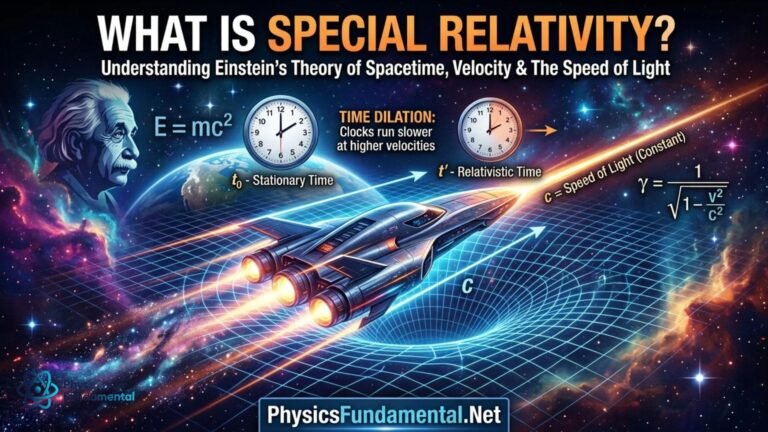
Imagine traveling through space at a speed incredibly close to the speed of light. Your watch still seems to tick normally to you, your spacecraft still feels ordinary, and you can measure its length just as you always have. But an observer watching you from Earth can measure a different passage of time and a…
When two objects collide, their motion can change dramatically in a fraction of a second. A moving ball may bounce backward, two vehicles may move together after impact, or tiny particles may scatter in different directions. These events are all examples of collisions, but they do not all behave in the same way. The key…
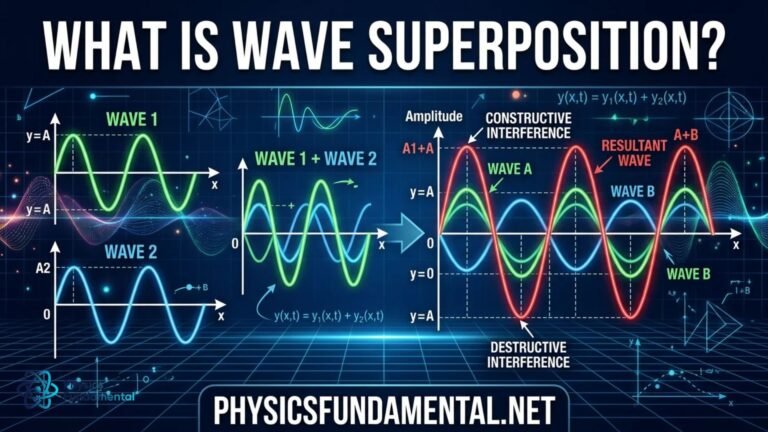
Wave superposition: when waves overlap, displacements add algebraically. In-phase constructive interference, anti-phase destructive. Standing waves and beats explained with worked examples.
Newton’s law of gravitation: F = Gm₁m₂/r² explained. Gravitational constant G, inverse-square law, orbital mechanics and worked examples.
When you push a heavy box across the floor, lift a bag from the ground, or pull an object with a rope, you are applying a force. But in physics, simply applying force does not always mean that work has been done. For work to occur, a force must cause an object to move, with…
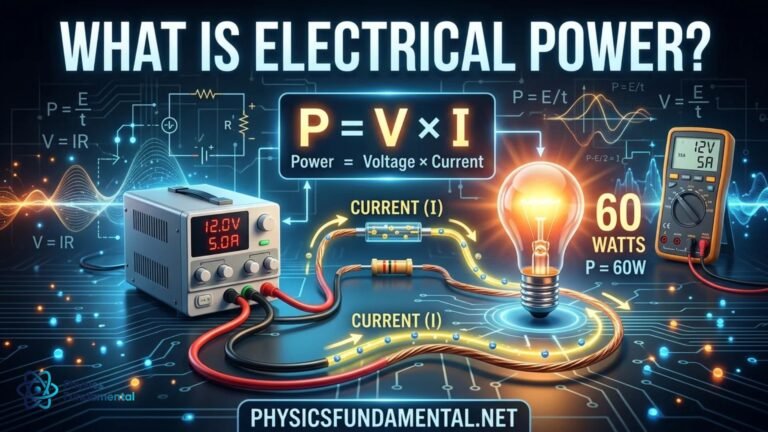
Electrical power P = IV = I²R = V²/R in watts. Energy dissipated in resistors, efficiency, kilowatt-hours on electricity bills, and 4 worked examples.
Have you ever wondered how a device can store electrical energy and release it when needed? A capacitor is one of the key components that makes this possible. It can store electric charge and energy, then release that stored energy into a circuit when required. So, what is capacitance? Capacitance is the ability of a…
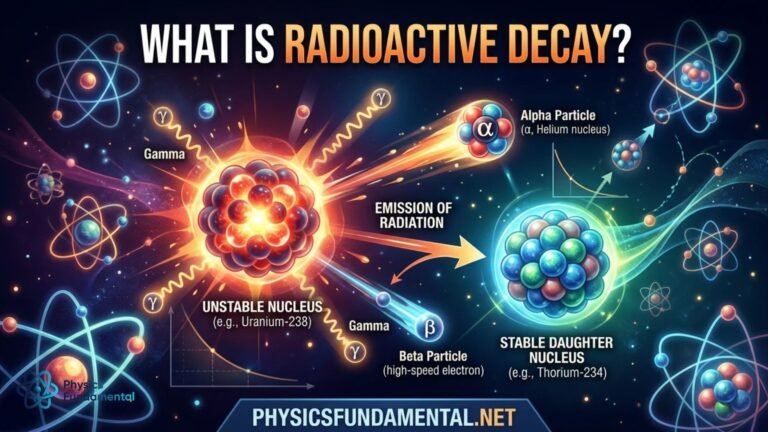
The three types of radioactive decay, how half-life actually works, and real applications from carbon dating to nuclear medicine, fully explained.
When a car turns around a corner, you may feel yourself pushed toward the outside of the turn. When a stone is tied to a string and swung in a circle, the string pulls the stone toward the center. These two experiences often create confusion: centripetal vs centrifugal force — which one is actually real?…