Power in Physics Explained: Powerful Formulas, Units & Examples 2026
Some machines can do the same amount of work as others, but they do not necessarily do it in the same amount of time. A powerful engine, for example, can transfer energy much faster than a weaker engine. This difference in the rate of doing work is described by Power in Physics.
Power measures how quickly energy is transferred or how quickly work is done. It is an important concept in mechanics, electricity, engines, machines, and many everyday systems. The basic formula is P = W/t, where P represents power, W represents work, and t represents time.
Power can also be expressed using energy, force, velocity, and electrical quantities. Understanding these relationships makes it easier to analyze everything from a person climbing stairs to an electric motor operating a machine.
What Is Power in Physics?
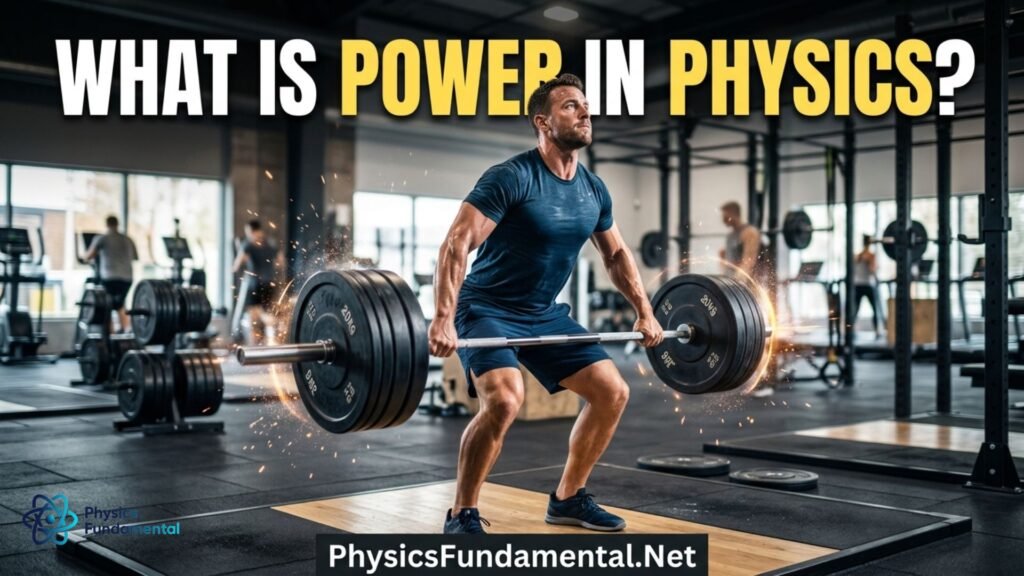
Power in Physics is the rate at which work is done or energy is transferred.
The average power is given by:
P = W/t
Where:
- P = average power
- W = work done
- t = time taken
Because work is a form of energy transfer, power can also be written as:
P = E/t
Where E represents the energy transferred.
In simple terms:
Power tells us how quickly energy is being transferred.
For example, if two machines perform the same amount of work, the machine that completes the work in less time has greater power.
SI Unit of Power
The SI unit of power is the watt, represented by W.
One watt is equal to one joule of energy transferred per second:
1 W = 1 J/s
For example, a device rated at 100 watts transfers energy at a rate of 100 joules per second under its rated operating conditions.
Larger units of power include:
- 1 kilowatt (kW) = 1,000 W
- 1 megawatt (MW) = 1,000,000 W
- 1 gigawatt (GW) = 1,000,000,000 W
Power is also commonly measured in horsepower for some engines and vehicles.
One mechanical horsepower is approximately:
1 hp ≈ 746 W
The exact value depends on the definition of horsepower being used.
Power Formula: P = W/t
The most basic power equation is:
P = W/t
This equation tells us that power increases when the same amount of work is completed in less time.
It can be rearranged to find work:
W = Pt
or time:
t = W/P
Worked Example: Finding Power
A machine performs 6,000 J of work in 20 s.
Using:
P = W/t
Substitute the values:
P = 6,000/20
P = 300 W
Therefore, the machine has an average power output of 300 watts.
Power and Energy
Power and energy are related, but they are not the same physical quantity.
Energy describes the capacity to cause change or perform work.
Power describes how quickly energy is transferred.
For example, imagine two batteries that each contain the same amount of usable energy. If one battery delivers that energy much faster, it has a greater power output during that period.
The relationship is:
P = E/t
Rearranging gives:
E = Pt
Therefore, if a device operates at constant power, the energy transferred increases with time.
Power and Work
Work is done when a force causes displacement in the direction of the force.
For a constant force:
W = Fd cosθ
Where:
- W = work
- F = force
- d = displacement
- θ = angle between force and displacement
Since:
P = W/t
we can substitute the work equation:
P = Fd cosθ/t
Because:
v = d/t
we obtain:
P = Fv cosθ
This is an important formula for mechanical power.
When the force and velocity point in the same direction, θ = 0°, so:
P = Fv
Mechanical Power
Mechanical power describes the rate at which mechanical work is performed or mechanical energy is transferred.
For a force acting in the same direction as an object’s velocity:
P = Fv
For example, if an engine produces a driving force of 2,000 N while a vehicle moves at 15 m/s:
P = Fv
P = 2,000 × 15
P = 30,000 W
Therefore:
P = 30 kW
This represents the mechanical power associated with that force at that speed.
Instantaneous Power
When force or velocity changes with time, power may also change.
The instantaneous power is:
P = dW/dt
For translational motion:
P = F · v
The dot product means:
P = Fv cosθ
This allows power to be calculated at a particular instant rather than over an entire time interval.
If force and velocity are parallel:
P = Fv
If they are perpendicular:
P = 0
This is because the force has no component in the direction of motion.
Power in Lifting Objects
Power is particularly useful for comparing how quickly machines or people can lift objects.
Suppose a mass m is lifted vertically at constant speed v.
The upward force required, ignoring air resistance and other effects, is approximately:
F = mg
Therefore:
P = Fv
so:
P = mgv
Where:
- m = mass
- g = gravitational acceleration
- v = upward velocity
Worked Example: Lifting a Mass
A machine lifts a 100 kg load vertically at 2 m/s. Take:
g = 9.8 m/s²
The force is:
F = mg
F = 100 × 9.8
F = 980 N
Now calculate power:
P = Fv
P = 980 × 2
P = 1,960 W
Therefore, the ideal mechanical power required is approximately:
1.96 kW
Real machines require additional power because of friction and other energy losses.
Power and Efficiency
Real machines are never perfectly efficient.
Some of the input energy may be transferred into:
- Heat
- Sound
- Vibration
- Air resistance
- Friction
- Electrical resistance
Efficiency compares useful output power with input power.
The formula is:
Efficiency = useful output power / input power × 100%
So:
η = (P_out/P_in) × 100%
For example, if a motor receives 1,000 W of input power and produces 800 W of useful mechanical output:
η = (800/1,000) × 100%
η = 80%
The motor therefore has an efficiency of 80% under those conditions.
Electrical Power
Power is also fundamental to electrical circuits.
The basic electrical power formula is:
P = VI
Where:
- P = electrical power in watts
- V = voltage in volts
- I = current in amperes
Using Ohm’s law:
V = IR
we can derive two additional power equations:
P = I²R
and:
P = V²/R
These equations are useful when different electrical quantities are known.
Worked Example: Electrical Power
A resistor has a voltage of 12 V across it and carries a current of 3 A.
Using:
P = VI
we get:
P = 12 × 3
P = 36 W
Therefore, the resistor transfers electrical energy at a rate of 36 joules per second.
Power in Series and Parallel Circuits
Power can be calculated for individual components and for an entire electrical circuit.
For a resistor:
P = I²R
In a series circuit, the same current flows through each ideal series component, so the power dissipated by each resistor depends on its resistance.
For a parallel circuit, the voltage across ideal branches is the same, so branch power can be calculated using:
P = V²/R
The total power is the sum of the power supplied to or dissipated by the individual components, subject to the circuit’s energy balance.
Power Dissipated by a Resistor
Electrical resistance converts electrical energy primarily into thermal energy.
The rate of this energy conversion is:
P = I²R
For example, if a resistor has:
I = 2 A
and:
R = 5 Ω
then:
P = I²R
P = (2)² × 5
P = 20 W
The resistor dissipates 20 W of electrical power as thermal energy under these conditions.
Power in Rotational Motion
Power also applies to rotating objects and machines.
For rotational motion:
P = τω
Where:
- P = power
- τ = torque
- ω = angular velocity
The unit of torque is newton-meter, while angular velocity is measured in radians per second.
For example, suppose a motor produces a torque of 50 N·m while rotating at 20 rad/s.
Then:
P = τω
P = 50 × 20
P = 1,000 W
So the mechanical power is:
1 kW
This relationship is especially important for motors, turbines, engines, and rotating machinery.
Power and Horsepower
Horsepower is a traditional unit used to describe the power of engines and machines.
For mechanical horsepower:
1 hp ≈ 746 W
Therefore, an engine rated at 100 hp has a power output of approximately:
100 × 746 = 74,600 W
or:
74.6 kW
Horsepower is still commonly used when discussing vehicle engines and some mechanical equipment, while watts and kilowatts are standard SI units.
You May Like to Read: Doppler Effect Explained: Powerful Pitch, Frequency & Wave Facts 2026
Average Power vs Instantaneous Power
There are two important ways to describe power.
Average Power
Average power is:
P_avg = W/Δt
It describes the total work or energy transferred divided by the total time interval.
Instantaneous Power
Instantaneous power is:
P = dW/dt
It describes the rate of energy transfer at a particular instant.
If power remains constant, average and instantaneous power have the same value.
If power changes significantly with time, they can be different.
Power in Different Physical Systems
Power is not limited to mechanical and electrical systems.
It can describe the rate of energy transfer in many areas of physics.
Thermal Systems
Power can describe the rate at which thermal energy is transferred.
For example, a heater rated at 2 kW transfers energy at a nominal rate of 2,000 J/s.
Waves
Waves can transfer energy from one location to another, so power can describe the rate of energy transfer carried by a wave.
Light
Light carries electromagnetic energy, and the power of a light source describes the rate at which it emits energy.
Engines
An engine’s power describes how quickly it can perform mechanical work or transfer mechanical energy.
Electric Motors
A motor converts electrical energy into mechanical energy, with power describing the rate of energy conversion.
Power and Force
Power is closely connected to force and velocity.
For translational motion:
P = F · v
This equation shows that an object can have high power because it experiences a large force, a high velocity, or both.
For example, two vehicles might experience similar driving forces, but the vehicle moving at a higher speed can have greater instantaneous mechanical power associated with that force.
This is one reason power is useful when comparing engines and machines.
Power and Speed
Power and speed are not exactly the same thing.
An object can move quickly while experiencing little force and therefore have relatively low mechanical power.
Similarly, an object can move slowly while a very large force acts on it, resulting in substantial power.
The relationship is:
P = Fv
So both force and velocity matter.
Power in Everyday Life
Power appears in many familiar situations.
When you:
- Climb stairs
- Run
- Lift a heavy object
- Drive a car
- Use a blender
- Charge a phone
- Operate an electric motor
- Heat water
- Run an air conditioner
energy is being transferred, and power describes the rate of that transfer.
For example, climbing the same staircase quickly requires a greater average power than climbing it slowly, assuming the same person and the same vertical height.
Common Mistakes About Power in Physics
Mistake 1: Confusing Power With Energy
Power is the rate of energy transfer, while energy is the amount transferred or stored.
Power = Energy/Time
Mistake 2: Thinking a Powerful Machine Always Uses More Energy
A powerful machine can transfer energy quickly, but total energy consumption depends on both power and operating time.
E = Pt
A high-power device operating for a short period can use less total energy than a lower-power device operating for a very long period.
Mistake 3: Forgetting the Direction of Force
The general mechanical power equation is:
P = Fv cosθ
Only the component of force along the velocity contributes to mechanical power.
Mistake 4: Confusing Watts With Joules
A joule measures energy.
A watt measures power.
The relationship is:
1 W = 1 J/s
Mistake 5: Assuming Efficiency Can Exceed 100%
For a conventional passive energy-conversion system, useful output energy cannot exceed the supplied input energy. An efficiency greater than 100% indicates an incorrect calculation or an inappropriate comparison of quantities.
How to Solve Power Problems
A simple method can make power calculations much easier.
Step 1: Identify What Is Given
Determine whether the problem provides:
- Work
- Energy
- Time
- Force
- Velocity
- Voltage
- Current
- Resistance
- Torque
- Angular velocity
Step 2: Choose the Appropriate Formula
Use:
P = W/t
for work and time.
Use:
P = E/t
for energy and time.
Use:
P = Fv
when force and velocity are in the same direction.
Use:
P = VI
for electrical power.
Use:
P = τω
for rotational systems.
Step 3: Convert Units
Make sure quantities use compatible SI units.
For example:
- Time should be in seconds.
- Energy should be in joules.
- Force should be in newtons.
- Velocity should be in meters per second.
- Voltage should be in volts.
- Current should be in amperes.
Step 4: Substitute and Calculate
Insert the values into the correct equation and calculate the result.
Step 5: Include the Correct Unit
Power is measured in watts unless another unit is specifically requested.
Power Formula Summary
| Concept | Formula |
|---|---|
| Average power | P = W/t |
| Power from energy | P = E/t |
| Instantaneous power | P = dW/dt |
| Mechanical power | P = Fv |
| General mechanical power | P = Fv cosθ |
| Lifting power | P = mgv |
| Electrical power | P = VI |
| Resistor power | P = I²R |
| Voltage-based electrical power | P = V²/R |
| Rotational power | P = τω |
| Energy from power | E = Pt |
| Efficiency | η = (P_out/P_in) × 100% |
Frequently Asked Questions
What is power in physics?
Power is the rate at which work is done or energy is transferred. Its SI unit is the watt.
What is the basic formula for power?
The basic formula is P = W/t, where P is power, W is work done, and t is the time taken.
What is the SI unit of power?
The SI unit of power is the watt (W). One watt equals one joule per second.
What is the difference between power and energy?
Energy is the amount of energy transferred or stored, while power tells us how quickly that energy is transferred.
What is the formula for electrical power?
Electrical power can be calculated using P = VI. For resistors, useful forms include P = I²R and P = V²/R.
Conclusion
Power in Physics measures how quickly work is done or energy is transferred. The fundamental relationship P = W/t provides the starting point for understanding power, while other equations extend the concept to mechanical, electrical, and rotational systems.
For mechanical motion, power can be calculated using P = Fv, while electrical power is commonly calculated using P = VI, P = I²R, or P = V²/R. In rotational systems, the useful relationship is P = τω.
Understanding power also helps distinguish it from energy. A machine with greater power can transfer energy faster, but the total energy used depends on both its power and the amount of time it operates. This makes power an essential concept for analyzing machines, vehicles, electrical devices, engines, and energy systems.