Tension Force Explained: Powerful Formula, Examples & Forces 2026
When an object is pulled by a rope, cable, or string, the rope transmits a force to the object. This pulling force is called tension force. It appears in many everyday situations, from lifting objects with cables to hanging masses from strings and analyzing pulley systems.
The tension force acts along the length of a stretched rope, string, or cable and pulls the connected object toward the rope. Unlike a pushing force, tension is a pulling force. In simple physics problems, a rope is often treated as massless and inextensible, which makes the tension easier to calculate.
Understanding tension is especially important when solving problems involving Newton’s laws, equilibrium, inclined planes, hanging objects, and pulley systems.
What Is Tension Force?
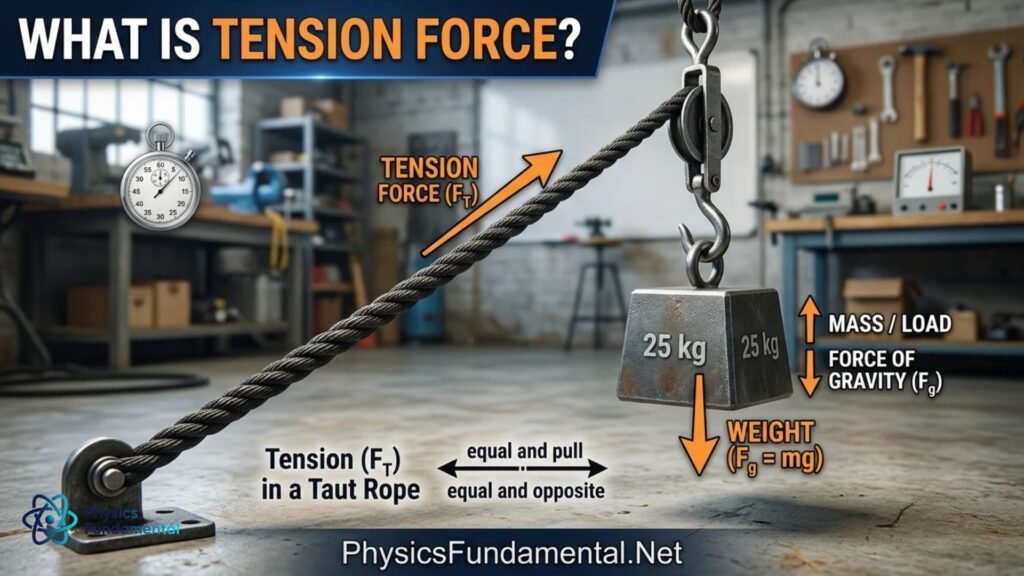
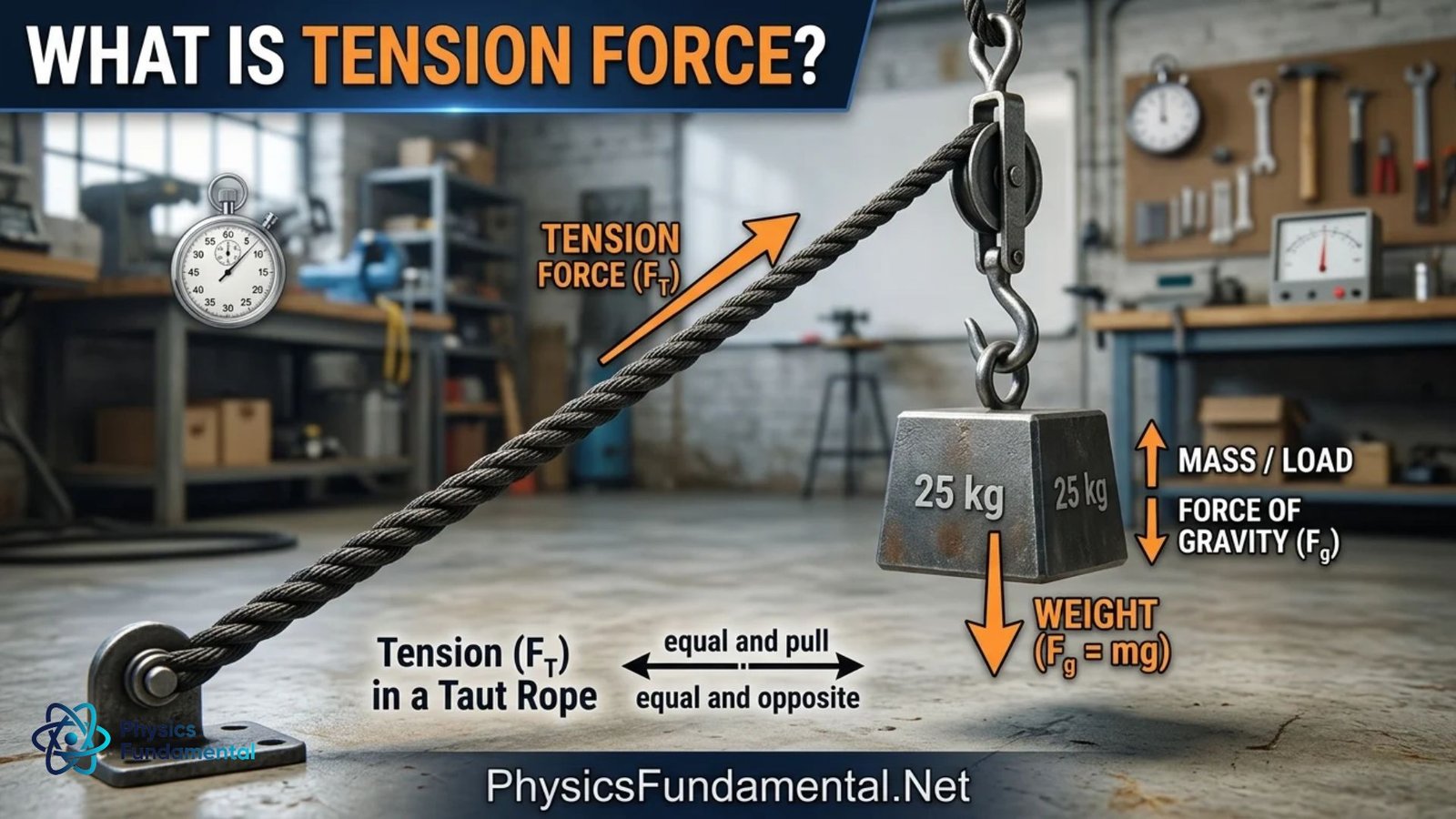
Tension force is the pulling force transmitted through a stretched rope, string, cable, or similar flexible connector.
Tension always acts along the length of the rope.
For example, if a mass hangs from a vertical string, the string pulls the mass upward.
        String
          ↑
          │
          │
        [ Mass ]
          ↓
          mg
The upward force from the string is the tension force, while the downward force is the object’s weight.
Tension is measured in newtons (N).
tension force and mechanics
What Direction Does Tension Act?
Tension acts away from the object and along the rope.
This is an important rule when drawing free-body diagrams.
For example, if an object is attached to a rope pulling toward the right:
[Object] --------→
             T
The tension force on the object points toward the rope.
If the rope pulls upward:
       ↑ T
       │
    [Object]
The tension acts upward.
Tension Force Formula
There is no single formula that applies to every tension problem.
The correct expression depends on the forces and acceleration in the system.
Newton’s second law provides the foundation:
ΣF = ma
For a simple object hanging at rest:
T = mg
where:
- T = tension
- m = mass
- g = gravitational acceleration
Near Earth’s surface:
g ≈ 9.8 m/s²
Therefore, a 5 kg object hanging at rest from a vertical rope has:
T = mg
T = 5 × 9.8
T = 49 N
So the tension is 49 N.
Tension in a Hanging Object at Rest
Consider an object hanging motionless from a rope.
Two main forces act on it:
- Tension upward
- Weight downward
Because the object is stationary:
a = 0
Newton’s second law gives:
ΣF = 0
Therefore:
T − mg = 0
So:
T = mg
Example
A 10 kg object hangs motionless from a cable.
Using:
T = mg
T = 10 × 9.8
T = 98 N
Therefore:
T = 98 N
The upward tension balances the object’s 98 N weight.
Tension When an Object Accelerates Upward
If an object accelerates upward, the tension must be greater than its weight.
Using upward as positive:
T − mg = ma
Rearrange:
T = m(g + a)
Example
A 5 kg object accelerates upward at 2 m/s².
T = m(g + a)
T = 5(9.8 + 2)
T = 5(11.8)
T = 59 N
The tension is therefore:
59 N
Notice that the tension is greater than the object’s weight of 49 N.
Tension When an Object Accelerates Downward
If an object accelerates downward, the tension is less than its weight.
Taking upward as positive:
T − mg = −ma
Therefore:
T = m(g − a)
Example
A 4 kg object accelerates downward at 3 m/s².
T = m(g − a)
T = 4(9.8 − 3)
T = 4(6.8)
T = 27.2 N
The tension is:
27.2 N
This is smaller than the object’s weight:
mg = 39.2 N
Tension in a Horizontal Rope
Tension does not always have to balance weight.
Consider an object pulled horizontally by a rope across a frictionless surface.
             T →
        [ Object ]
If the object has mass m and acceleration a:
T = ma
Example
A 6 kg box is pulled horizontally with an acceleration of 3 m/s² on a frictionless surface.
T = ma
T = 6 × 3
T = 18 N
Therefore:
T = 18 N
Gravity and the normal force cancel vertically, so they do not affect the horizontal tension in this simplified example.
Tension and Friction
If an object is pulled horizontally while friction acts against its motion, tension must overcome both friction and provide the required acceleration.
Newton’s second law becomes:
T − f = ma
Therefore:
T = ma + f
where f is the frictional force.
Example
A 10 kg box is pulled with an acceleration of 2 m/s² while friction is 15 N.
Then:
T − 15 = 10(2)
T − 15 = 20
Therefore:
T = 35 N
The rope must provide 35 N of tension.
Tension on an Inclined Plane
Tension problems become more interesting when an object is placed on an inclined plane.
Suppose a box is connected to a rope parallel to the slope.
The weight can be divided into components:
mg sinθ
parallel to the slope, and:
mg cosθ
perpendicular to the slope.
If the object is stationary and there is no friction:
T = mg sinθ
Example
A 10 kg object rests on a frictionless slope inclined at 30° and is held by a rope parallel to the slope.
The component of weight down the slope is:
mg sinθ
Therefore:
T = 10 × 9.8 × sin30°
Since:
sin30° = 0.5
we get:
T = 49 N
So the tension is 49 N.
Tension in a Two-Rope System
An object can be supported by more than one rope.
For example:
        \ T₁
         \
          [Object]
         /
        / T₂
In such situations, each tension force has its own direction.
The tensions must be resolved into horizontal and vertical components.
For equilibrium:
ΣFₓ = 0
and:
ΣFᵧ = 0
This allows the unknown tensions to be calculated.
Tension in a Simple Pulley System
Pulleys are commonly used in tension problems.
Consider two masses connected by a rope passing over an ideal pulley.
       ______
      /      \
     O        \
    /          \
 [m₁]         [m₂]
If the rope is massless and the pulley is ideal, the tension is the same throughout the rope.
For mass m₁:
T − m₁g = m₁a
For mass m₂:
m₂g − T = m₂a
These two equations can be solved simultaneously.
Worked Example: Two Hanging Masses
Suppose two masses are connected by a light rope over an ideal pulley:
m₁ = 2 kg
m₂ = 5 kg
The heavier mass moves downward while the lighter mass moves upward.
For the 2 kg mass:
T − 2g = 2a
For the 5 kg mass:
5g − T = 5a
Adding the equations:
3g = 7a
Therefore:
a = 3g/7
Using g = 9.8 m/s²:
a ≈ 4.2 m/s²
Now substitute into:
T − 2g = 2a
T = 2g + 2a
T ≈ 19.6 + 8.4
T ≈ 28 N
So the tension is approximately:
28 N
Does Tension Always Equal Weight?
No.
Tension equals weight only in specific situations, such as an object hanging at rest from a single vertical rope with no other vertical forces.
If the object accelerates, tension changes.
For an object accelerating upward:
T > mg
For an object accelerating downward:
T < mg
For an object at rest:
T = mg
assuming these are the only vertical forces.
You May Like to Read: Vectors and Scalars Explained: Powerful Differences, Examples & Rules 2026
Does Tension Have a Maximum Value?
Real ropes and cables can only withstand a certain amount of tension before stretching excessively or breaking.
The maximum safe tension depends on:
- Material
- Diameter
- Construction
- Temperature
- Condition of the rope
- Safety factor
In ideal physics problems, ropes are often assumed to be perfectly strong, massless, and inextensible.
Real systems require more detailed analysis.
Ideal Rope Assumptions
Many introductory tension problems make three simplifying assumptions.
Massless Rope
The rope’s mass is considered negligible.
Inextensible Rope
The rope does not stretch.
Ideal Pulley
An ideal pulley is considered frictionless and massless.
Under these assumptions, the tension can be treated as the same throughout a continuous rope.
Real systems may not behave exactly this way.
Tension vs Compression
Tension and compression are opposite types of mechanical loading.
Tension occurs when an object is pulled apart.
Compression occurs when an object is pushed together.
A rope can normally transmit tension but cannot effectively push an object because it would simply go slack.
This is why ropes, strings, and cables are commonly modeled as tension-only connectors.
Tension and Newton’s Laws
Tension force problems are applications of Newton’s laws of motion.
Newton’s second law states:
ΣF = ma
The first step in most tension problems is therefore to identify every force acting on each object.
Typical forces include:
- Tension
- Weight
- Normal force
- Friction
- Applied force
- Air resistance
Once the forces are identified, write the appropriate force equation in each direction.
Free-Body Diagrams for Tension
A free-body diagram is one of the most useful tools for solving tension problems.
For a hanging object:
        ↑ T
        │
      [ m ]
        │
        ↓ mg
If the object is stationary:
T = mg
If it accelerates upward:
T − mg = ma
If it accelerates downward:
mg − T = ma
The free-body diagram makes the force directions clear before any calculations are performed.
Tension in Circular Motion
Tension can also provide the centripetal force required for circular motion.
For an object attached to a string and moving in a horizontal circle:
T = mv²/r
in the simplified case where tension is the sole horizontal radial force.
Here:
- m = mass
- v = speed
- r = radius
This equation comes from:
F_c = mv²/r
The exact tension depends on the geometry and the other forces present.
Tension in a Vertical Circle
When an object moves in a vertical circle, tension and gravity can both contribute to the radial force.
At the bottom of the circle:
T − mg = mv²/r
Therefore:
T = mg + mv²/r
At the top, depending on the direction convention:
T + mg = mv²/r
Therefore:
T = mv²/r − mg
These expressions show that tension can vary around the circular path.
Common Mistakes With Tension Force
Mistake 1: Always Setting T = mg
This is only correct for particular equilibrium situations.
Mistake 2: Forgetting Direction
Tension always acts along the rope and pulls the object toward the rope.
Mistake 3: Ignoring Other Forces
Friction, weight, normal force, and applied forces may all affect tension.
Mistake 4: Using the Same Tension in Every Real System
Equal tension throughout a rope is an idealization. It is appropriate for a massless rope with an ideal setup.
Mistake 5: Confusing Tension With the Force the Object Exerts on the Rope
Forces come in interaction pairs. The rope pulls the object, while the object pulls back on the rope with an equal and opposite force.
Tension Force Formula Summary
Some important tension relationships are:
Object at Rest
T = mg
Object Accelerating Upward
T = m(g + a)
Object Accelerating Downward
T = m(g − a)
Horizontal Frictionless Motion
T = ma
Horizontal Motion With Friction
T − f = ma
Object on a Frictionless Incline
T = mg sinθ
when the rope holds the object stationary and is parallel to the incline.
Circular Motion
T = mv²/r
when tension alone supplies the relevant radial force.
Remember that these formulas apply to particular physical arrangements. The most general starting point is always:
ΣF = ma
Frequently Asked Questions
What is tension force?
Tension force is a pulling force transmitted through a stretched rope, string, cable, or similar connector.
What is the formula for tension force?
There is no single formula for every situation. For a stationary hanging object, T = mg. More generally, tension is found using ΣF = ma.
Does tension always equal weight?
No. Tension equals weight when a hanging object is in equilibrium and no other vertical forces act on it.
Can tension push an object?
No. An ideal rope or string can pull but cannot push. If it would need to push, the rope generally becomes slack.
What unit is tension measured in?
Tension is a force, so its SI unit is the newton (N).
Conclusion
Tension force is a pulling force transmitted through ropes, strings, cables, and similar connectors. It always acts along the connector and pulls the attached object toward it.
The simplest tension problem involves a stationary hanging object, where:
T = mg
But tension can change when an object accelerates, when friction is present, when a rope passes over a pulley, or when an object moves in a circle. In these situations, Newton’s second law provides the general framework:
ΣF = ma
Drawing a clear free-body diagram, choosing a positive direction, and accounting for every force are the most reliable steps for solving tension problems. Once these fundamentals are understood, more complex systems involving pulleys, inclined planes, connected masses, and circular motion become much easier to analyze.