What Are Electromagnetic Waves? Speed, Spectrum and Properties
Light from the Sun, radio signals, Wi-Fi, X-rays, and microwaves may seem completely different, but they all belong to the same family: electromagnetic waves. These waves can travel through empty space without needing air, water, or another material medium.
Electromagnetic waves are waves made of oscillating electric and magnetic fields that propagate through space. In a vacuum, all electromagnetic waves travel at the same speed—the speed of light, approximately 3.00 × 10⁸ meters per second. Their main difference is their frequency and wavelength, which determine where they fall in the electromagnetic spectrum and how they interact with matter.
From radio communication to medical imaging and visible light, electromagnetic waves are essential to modern technology and everyday life. Understanding their speed, spectrum, properties, and behavior helps explain how wireless communication, sunlight, radar, television, and many medical technologies work.
What Are Electromagnetic Waves?
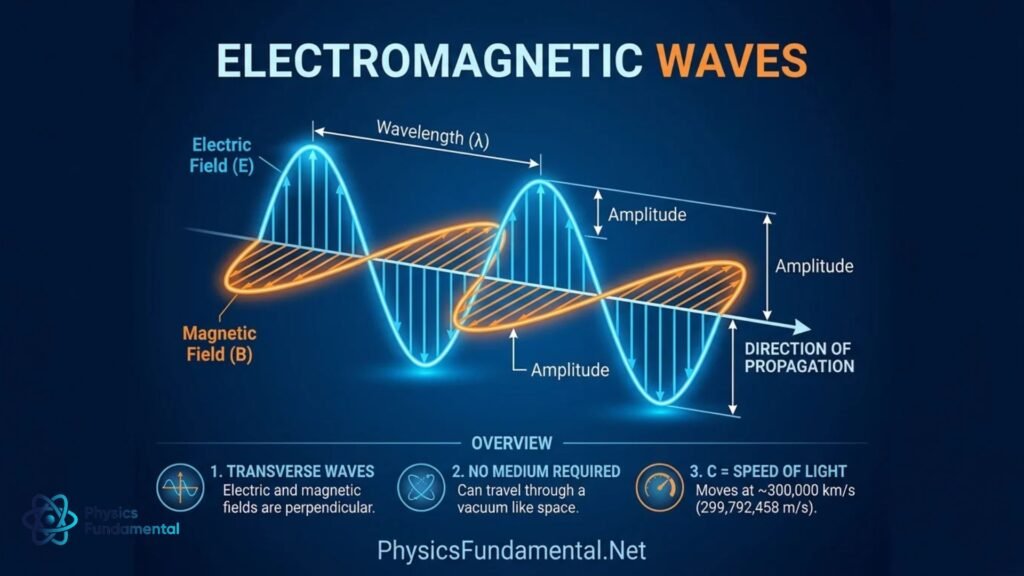
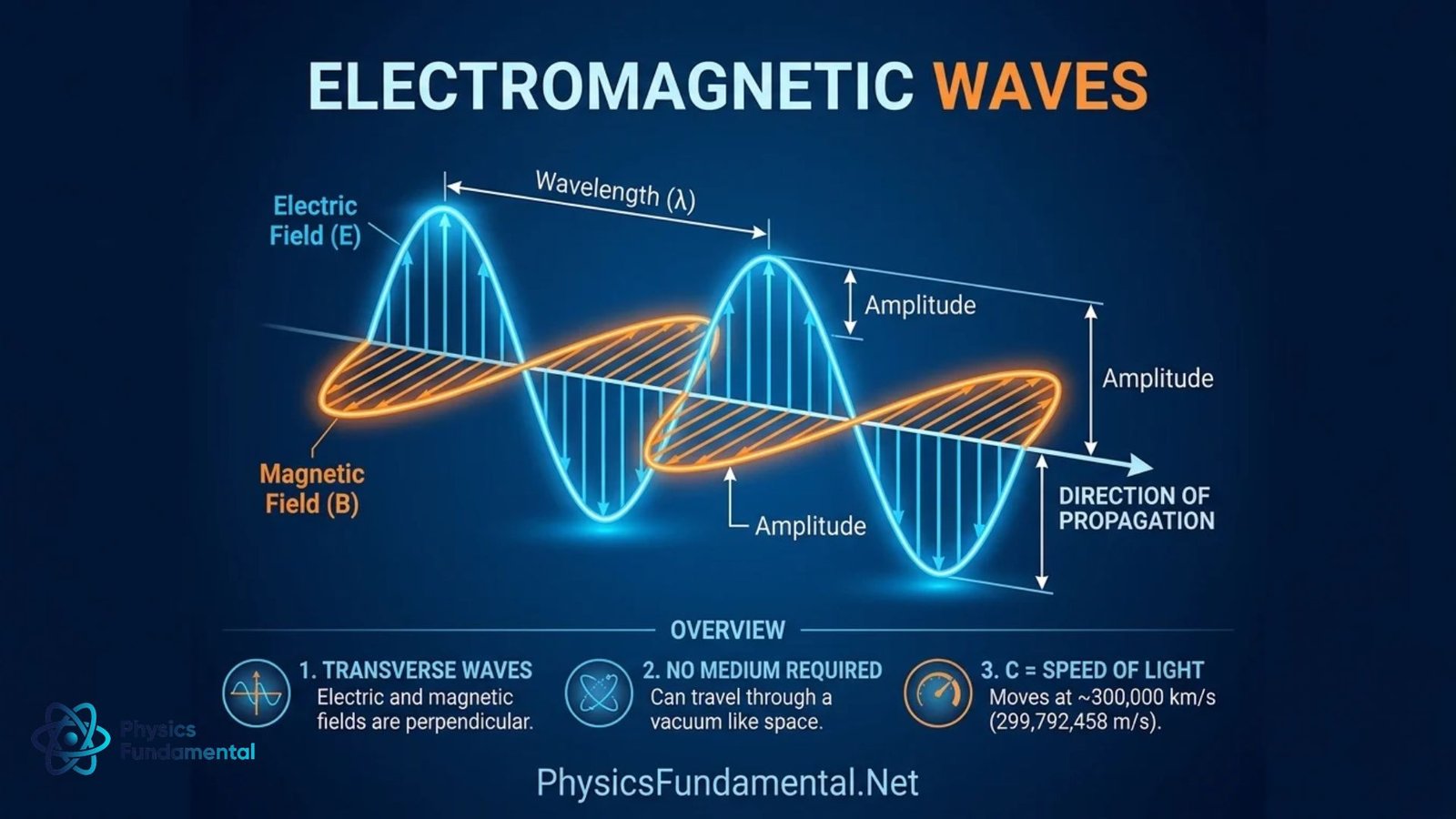
Electromagnetic waves are traveling disturbances consisting of changing electric and magnetic fields. The electric field and magnetic field oscillate perpendicular to each other, while both are perpendicular to the direction in which the wave travels.
Unlike mechanical waves, electromagnetic waves do not require a material medium. For example, sound needs a medium such as air to travel, but sunlight can travel from the Sun to Earth through the vacuum of space.
The behavior of electromagnetic waves is described by classical electromagnetism, particularly the relationship between electric and magnetic fields developed through electromagnetic wave theory.
An electromagnetic wave can be represented by three mutually perpendicular directions:
- Electric field: oscillates in one direction
- Magnetic field: oscillates perpendicular to the electric field
- Direction of propagation: perpendicular to both fields
This makes electromagnetic waves transverse waves.
How Do Electromagnetic Waves Travel?
Electromagnetic waves are produced when electric charges accelerate. A changing electric field produces a changing magnetic field, and a changing magnetic field produces a changing electric field.
These changing fields can sustain each other as the disturbance moves through space.
For a simple electromagnetic wave traveling in the x-direction:
- The electric field may oscillate along the y-axis.
- The magnetic field may oscillate along the z-axis.
- The wave itself moves along the x-axis.
The fields continuously change as the wave propagates.
This relationship is one of the most important characteristics of electromagnetic radiation.
Speed of Electromagnetic Waves
In a vacuum, every electromagnetic wave travels at approximately the same speed:
c = 3.00 × 10⁸ m/s
Here:
- c = speed of light in vacuum
- 3.00 × 10⁸ m/s = approximately 300,000 km/s
This means radio waves, visible light, ultraviolet radiation, X-rays, and gamma rays all travel at the same speed through a vacuum.
Their frequencies and wavelengths are different, but their vacuum speed is the same.
Speed in a Medium
Electromagnetic waves generally travel more slowly when they pass through a material such as glass or water.
The approximate relationship is:
v = c/n
where:
- v = speed of light in the medium
- c = speed of light in vacuum
- n = refractive index of the material
For example, if a material has a refractive index of 1.5:
v = (3.00 × 10⁸)/1.5
v = 2.00 × 10⁸ m/s
So the wave travels more slowly through that material than through a vacuum.
Wavelength and Frequency
Two of the most important properties of electromagnetic waves are wavelength and frequency.
Wavelength
Wavelength, represented by λ (lambda), is the distance between corresponding points on consecutive waves, such as crest to crest.
It is measured in meters.
Frequency
Frequency, represented by f, is the number of complete wave cycles passing a point each second.
It is measured in hertz (Hz).
One hertz means one cycle per second.
The relationship between speed, wavelength, and frequency is:
c = fλ
For electromagnetic waves in a vacuum:
fλ = c
This equation shows that wavelength and frequency are inversely related.
If frequency increases, wavelength decreases.
If frequency decreases, wavelength increases.
Example
Suppose an electromagnetic wave has a frequency of 6.0 × 10¹⁴ Hz. Its wavelength in vacuum is:
λ = c/f
λ = (3.00 × 10⁸)/(6.0 × 10¹⁴)
λ = 5.0 × 10⁻⁷ m
This is equal to 500 nm, which falls within the visible-light region.
The Electromagnetic Spectrum
The electromagnetic spectrum is the complete range of electromagnetic radiation arranged according to frequency or wavelength.
From lowest frequency and longest wavelength to highest frequency and shortest wavelength, the major categories are:
- Radio waves
- Microwaves
- Infrared
- Visible light
- Ultraviolet
- X-rays
- Gamma rays
Although these categories have different properties and applications, they are all electromagnetic waves.
1. Radio Waves
Radio waves have the longest wavelengths and generally the lowest frequencies in the electromagnetic spectrum.
They are widely used for communication.
Common applications include:
- Radio broadcasting
- Television transmission
- Wireless communication
- Aircraft communication
- Marine communication
- Some navigation systems
Radio waves can travel long distances and can be transmitted and received using antennas.
2. Microwaves
Microwaves have shorter wavelengths and higher frequencies than most radio waves.
They are used in many technologies, including:
- Microwave ovens
- Radar
- Satellite communication
- Wireless communication
- Mobile networks
- Some navigation systems
Microwaves can transfer energy to matter and are particularly useful for heating certain materials containing polar molecules such as water.
3. Infrared Waves
Infrared radiation lies between microwaves and visible light.
It is strongly associated with thermal radiation because warm objects emit infrared radiation.
Applications include:
- Thermal imaging
- Remote controls
- Heat sensors
- Night-vision equipment
- Infrared spectroscopy
- Heating systems
Objects at ordinary temperatures continuously emit infrared radiation.
4. Visible Light
Visible light is the portion of the electromagnetic spectrum that can be detected by the human eye.
Its wavelengths are approximately in the range of 400 to 700 nanometers, although the exact boundaries depend on the definition used.
Visible light includes colors such as:
- Violet
- Blue
- Green
- Yellow
- Orange
- Red
Violet light has a higher frequency and shorter wavelength than red light.
Red light has a lower frequency and longer wavelength than violet light.
5. Ultraviolet Radiation
Ultraviolet, or UV, radiation has a higher frequency than visible violet light.
The Sun is a major natural source of ultraviolet radiation.
UV radiation has useful applications, including:
- Sterilization
- Fluorescence
- Photolithography
- Certain medical treatments
- Forensic analysis
However, excessive exposure to ultraviolet radiation can damage biological tissue, so appropriate protection is important.
6. X-Rays
X-rays have much higher frequencies and shorter wavelengths than ultraviolet radiation.
They can penetrate many materials, making them extremely useful for imaging inside objects and the human body.
Major applications include:
- Medical X-ray imaging
- Security scanning
- Industrial inspection
- Materials analysis
- Scientific research
X-rays have enough energy to cause changes in atoms and molecules, so exposure needs to be controlled.
7. Gamma Rays
Gamma rays generally occupy the highest-frequency, shortest-wavelength region of the electromagnetic spectrum.
They can be produced by certain nuclear processes and other high-energy events.
Applications include:
- Cancer treatment
- Sterilization of medical equipment
- Nuclear medicine
- Scientific research
- Industrial inspection
Because gamma rays are highly energetic and ionizing, they can damage living cells at sufficient exposure levels.
Electromagnetic Spectrum at a Glance
| Type | Relative Wavelength | Relative Frequency | Common Applications |
|---|---|---|---|
| Radio waves | Longest | Lowest | Broadcasting, communication |
| Microwaves | Long | Low | Radar, satellites, heating |
| Infrared | Moderate | Moderate | Thermal imaging, remote controls |
| Visible light | Short | Higher | Vision, lighting, optics |
| Ultraviolet | Shorter | High | Sterilization, fluorescence |
| X-rays | Very short | Very high | Medical imaging |
| Gamma rays | Shortest | Highest | Cancer treatment, nuclear medicine |
The boundaries between these regions are not always sharp. Different scientific and engineering sources may use slightly different wavelength or frequency ranges.
Important Properties of Electromagnetic Waves
Electromagnetic waves have several properties that distinguish them from mechanical waves.
1. They Can Travel Through a Vacuum
This is one of their most important characteristics.
Because electromagnetic waves do not require particles for propagation, they can travel through empty space.
This is how energy from the Sun reaches Earth.
2. They Are Transverse Waves
The electric and magnetic fields oscillate perpendicular to the direction of propagation.
Therefore, electromagnetic waves are transverse.
3. They Carry Energy
Electromagnetic waves transport energy from one location to another.
Sunlight, for example, carries energy from the Sun to Earth.
The amount of energy associated with individual photons depends on frequency:
E = hf
where:
- E = photon energy
- h = Planck’s constant
- f = frequency
Therefore, higher-frequency electromagnetic radiation has higher energy per photon.
4. They Carry Momentum
Electromagnetic radiation also carries momentum.
This means electromagnetic waves can exert pressure when they interact with matter. This effect is called radiation pressure.
You May Like to Read: Carnot Cycle Explained: Powerful Heat Engine Efficiency Guide 2026
5. They Can Be Reflected
Electromagnetic waves can bounce from surfaces.
For example:
- Mirrors reflect visible light.
- Radar waves can reflect from objects.
- Radio waves can reflect under suitable conditions.
6. They Can Be Refracted
When electromagnetic waves enter a different medium, their speed changes. This can cause their direction to change.
This phenomenon is called refraction.
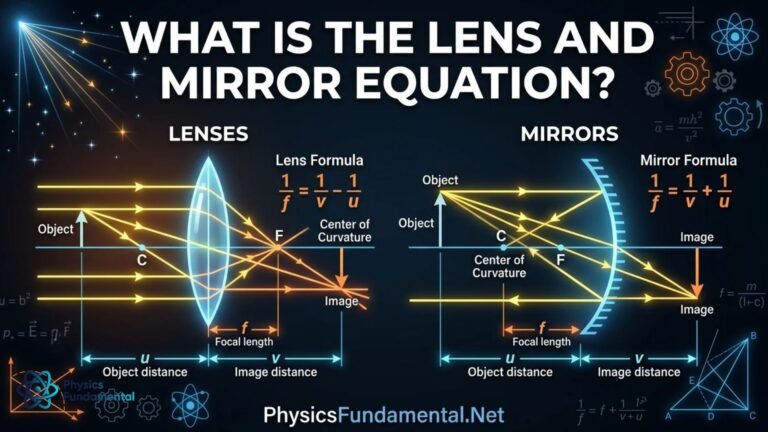
Lenses use refraction to focus visible light.
7. They Can Undergo Diffraction
Electromagnetic waves can bend and spread when passing through openings or around obstacles.
The effect becomes especially noticeable when the size of an opening or obstacle is comparable to the wavelength.
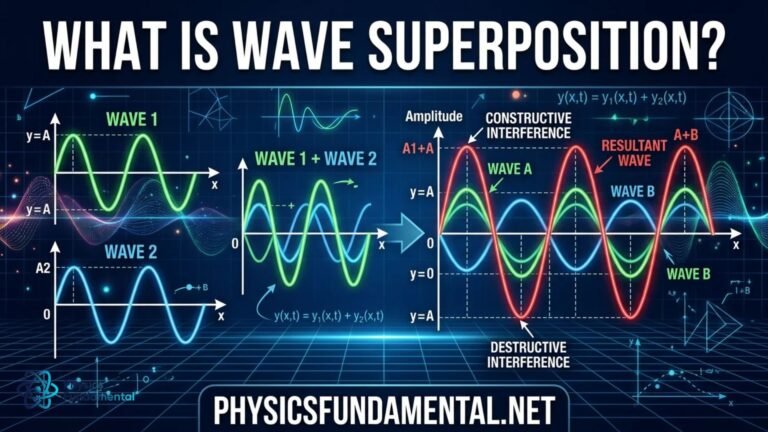
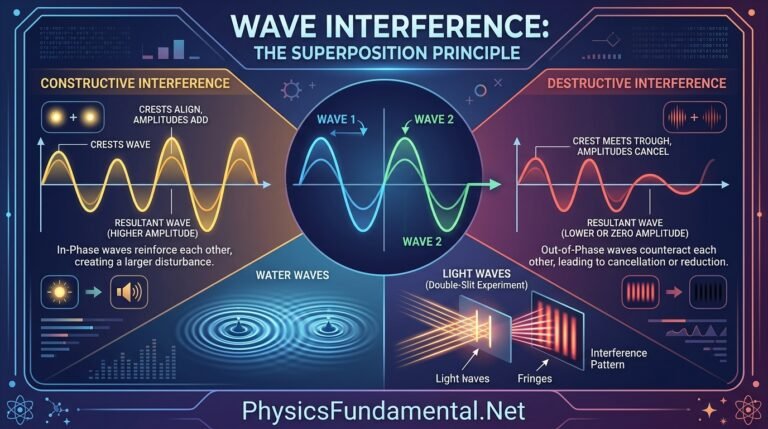
8. They Can Interfere
Two or more electromagnetic waves can overlap and produce interference.
Depending on their phase, they may reinforce or partially cancel each other.
This explains phenomena such as interference patterns in optics.
9. They Can Be Polarized
Because electromagnetic waves are transverse, they can be polarized.
Polarization restricts the direction of electric-field oscillation.
Polarized sunglasses are a familiar example of a technology based on this property.
Electromagnetic Waves and Energy
The energy of electromagnetic radiation can be described in terms of photons.
The photon energy equation is:
E = hf
Since:
c = fλ
we can also write:
E = hc/λ
This equation shows that photon energy increases as wavelength decreases.
Therefore:
- Long wavelength → lower frequency → lower photon energy
- Short wavelength → higher frequency → higher photon energy
This is why gamma rays have much greater photon energies than radio waves.
Are All Electromagnetic Waves the Same?
In one fundamental sense, yes. Radio waves, visible light, X-rays, and gamma rays are all forms of electromagnetic radiation.
However, they differ significantly in frequency, wavelength, photon energy, and how they interact with matter.
For example, radio waves can be used to transmit information over long distances, while X-rays can pass through soft tissue and create internal images.
The difference comes primarily from where they fall in the electromagnetic spectrum.
How Are Electromagnetic Waves Generated?
Electromagnetic radiation can be generated by accelerating electric charges.
Different physical processes produce different parts of the spectrum.
Examples include:
- Radio transmitters produce radio-frequency radiation.
- Molecular motion and thermal processes produce infrared radiation.
- Atomic transitions can produce visible and ultraviolet radiation.
- High-energy electronic processes can produce X-rays.
- Nuclear transitions can produce gamma rays.
The exact mechanism depends on the type and energy of the source.
Electromagnetic Waves in Everyday Life
Electromagnetic waves are present throughout everyday life.
When you use a mobile phone, electromagnetic radiation carries signals between devices and communication networks.
Wi-Fi uses radio-frequency electromagnetic waves to transmit data.
A microwave oven uses electromagnetic radiation to transfer energy to food.
A television screen produces visible light that reaches your eyes.
A remote control commonly uses infrared radiation.
Medical imaging systems use X-rays to create images of internal structures.
So electromagnetic waves are not limited to visible light. Most of the electromagnetic spectrum is invisible to human eyes.
Electromagnetic Waves vs Mechanical Waves
Electromagnetic waves and mechanical waves differ in several important ways.
| Property | Electromagnetic Waves | Mechanical Waves |
|---|---|---|
| Need a medium? | No | Yes |
| Can travel through vacuum? | Yes | No |
| Example | Light | Sound |
| Nature | Transverse in free space | Can be transverse or longitudinal |
| Main mechanism | Changing electric and magnetic fields | Oscillations of matter |
Sound is a mechanical wave because it requires a material medium.
Light is an electromagnetic wave and can travel through the vacuum of space.
Worked Example: Finding Wavelength
A radio wave has a frequency of 1.0 × 10⁸ Hz. What is its wavelength in vacuum?
Use:
c = fλ
Rearrange:
λ = c/f
Substitute the values:
λ = (3.00 × 10⁸)/(1.0 × 10⁸)
Therefore:
λ = 3.0 m
So the wavelength of the radio wave is approximately 3 meters.
Worked Example: Finding Frequency
Suppose visible light has a wavelength of 600 nm.
First convert nanometers into meters:
600 nm = 600 × 10⁻⁹ m
Using:
f = c/λ
we get:
f = (3.00 × 10⁸)/(600 × 10⁻⁹)
f ≈ 5.0 × 10¹⁴ Hz
So the frequency is approximately 5.0 × 10¹⁴ Hz.
Why Is the Speed of Light So Important?
The speed of light is one of the fundamental constants of physics.
In a vacuum:
c = 299,792,458 m/s
This value is exact in the modern SI system because the meter is defined using the speed of light.
The enormous speed of electromagnetic waves allows information and energy to travel across large distances very quickly, although communication over astronomical distances still experiences noticeable time delays.
For example, sunlight takes about 8 minutes and 20 seconds to reach Earth from the Sun.
Common Misconceptions About Electromagnetic Waves
Electromagnetic waves need air to travel
False. Electromagnetic waves can travel through a vacuum.
Only visible light is electromagnetic radiation
False. Radio waves, microwaves, infrared, ultraviolet, X-rays, and gamma rays are also electromagnetic radiation.
All electromagnetic waves have different speeds in vacuum
False. In vacuum, all electromagnetic radiation propagates at the same speed c.
Higher frequency means longer wavelength
False. In a vacuum, frequency and wavelength are inversely proportional.
c = fλ
As frequency increases, wavelength decreases.
Electromagnetic waves and sound waves are the same
False. Sound is a mechanical wave and requires a material medium, while electromagnetic waves can travel through vacuum.
Formula Summary
The most important equations related to electromagnetic waves are:
c = fλ
Relates speed, frequency, and wavelength.
v = c/n
Gives the approximate speed of light in a medium.
E = hf
Gives the energy of a photon.
E = hc/λ
Relates photon energy directly to wavelength.
Remember that c refers specifically to the speed of electromagnetic waves in vacuum, while v can represent their speed in a material medium.
Frequently Asked Questions
What are electromagnetic waves?
Electromagnetic waves are oscillating electric and magnetic fields that transfer energy through space. They can travel through a vacuum without requiring a material medium.
What is the speed of electromagnetic waves?
In a vacuum, electromagnetic waves travel at exactly 299,792,458 m/s, commonly approximated as 3.00 × 10⁸ m/s.
What are the seven types of electromagnetic waves?
The main regions are radio waves, microwaves, infrared, visible light, ultraviolet, X-rays, and gamma rays.
Which electromagnetic wave has the highest frequency?
Gamma rays occupy the highest-frequency region of the electromagnetic spectrum and have the shortest wavelengths.
Do electromagnetic waves need a medium?
No. Electromagnetic waves can travel through a vacuum, unlike mechanical waves such as sound.
Conclusion
Electromagnetic waves are fundamental to both nature and modern technology. They consist of changing electric and magnetic fields and can travel through empty space at the speed of light. Their wavelength, frequency, and photon energy determine where they fall within the electromagnetic spectrum.
The electromagnetic spectrum ranges from low-frequency radio waves to extremely high-frequency gamma rays. Although these forms of radiation have different applications and interactions with matter, they are all manifestations of the same fundamental electromagnetic phenomenon.
Understanding electromagnetic waves provides a foundation for studying optics, communication systems, radiation, astronomy, electronics, and many other areas of physics. From the sunlight reaching Earth to the signals connecting wireless devices, electromagnetic waves are constantly transferring energy and information around us.