Speed of Light Explained: Powerful Facts, Formula & History 2026
Light travels incredibly fast. In a vacuum, the Speed of Light is exactly 299,792,458 meters per second. That means light can travel around Earth more than seven times in a single second.
But how did scientists discover that light has a finite speed? For centuries, people debated whether light traveled instantaneously. Early experiments struggled to measure its speed because light moves so quickly. Scientists eventually developed increasingly sophisticated methods, beginning with astronomical observations and later using rotating wheels, mirrors, electrical instruments, and lasers.
Today, the speed of light is one of the most important constants in physics. It appears in electromagnetism, Einstein’s theory of relativity, energy-mass equivalence, astronomy, telecommunications, and modern definitions of distance and time.
What Is the Speed of Light?
The speed of light in a vacuum is represented by the symbol:
c
Its exact value is:
c = 299,792,458 m/s
It can also be written approximately as:
c ≈ 3.00 × 10⁸ m/s
In kilometers per second:
c ≈ 299,792.458 km/s
For everyday calculations, scientists often use:
c ≈ 300,000 km/s
The exact value is important because the meter is now defined using the speed of light.
The concept of speed of light and electromagnetic radiation is fundamental to modern physics.
How Fast Does Light Travel?
The Speed of Light in a vacuum is approximately:
300,000 km/s
At this speed, light can travel:
- Around Earth in roughly 0.13 seconds
- From the Moon to Earth in about 1.28 seconds
- From the Sun to Earth in about 8 minutes 20 seconds
- From Earth to Mars in several minutes, depending on their positions
- Across one light-year in one year
The exact travel time between planets varies because their distances from Earth constantly change as they orbit the Sun.
How Far Does Light Travel in One Second?
Using:
d = ct
For one second:
d = (299,792,458)(1)
Therefore:
d = 299,792,458 m
or:
d = 299,792.458 km
So light travels almost 300 million kilometers in one second through a vacuum.
How Far Does Light Travel in One Minute?
One minute contains:
60 seconds
Therefore:
d = ct
d = 299,792,458 × 60
d = 17,987,547,480 m
This is approximately:
17.99 billion meters
or:
17.99 million kilometers
Light travels nearly 18 million kilometers in one minute.
How Long Does Sunlight Take to Reach Earth?
The average distance between the Sun and Earth is approximately:
1.496 × 10¹¹ m
Using:
t = d/c
we get:
t = (1.496 × 10¹¹)/(2.998 × 10⁸)
This gives approximately:
t ≈ 499 seconds
Converting to minutes:
t ≈ 8.32 minutes
Therefore, sunlight takes about 8 minutes 20 seconds to reach Earth.
This also means that when we observe the Sun, we see it as it was approximately eight minutes earlier.
Why Is the Speed of Light So Important?
The Speed of Light is not simply the speed at which visible light travels.
It is a fundamental constant that connects space and time in modern physics.
It appears in:
- Special relativity
- General relativity
- Electromagnetism
- Quantum physics
- Astronomy
- Particle physics
- Cosmology
- Telecommunications
- GPS technology
Einstein’s theory of special relativity shows that the speed of light in vacuum is the same for all inertial observers, regardless of the motion of the light source or observer.
Early Ideas About the Speed of Light
For much of ancient history, some philosophers considered light to travel instantaneously.
If light traveled infinitely fast, then a beam from one location would reach another location with no measurable delay.
The problem was that any laboratory experiment would need to measure an extremely tiny travel time.
For short distances, the required timing accuracy was far beyond early scientific instruments.
Astronomical distances eventually provided a solution.
Galileo’s Attempt to Measure Light Speed
Galileo Galilei is associated with one of the earliest attempts to determine whether light had a finite speed.
The basic idea involved two people standing at a known distance from each other, each carrying a covered lantern.
One person would uncover a lantern, and the other would uncover theirs after seeing the first light.
The experiment was repeated with larger distances.
If light had a measurable travel time, increasing the distance should have produced a measurable delay.
However, the distances involved were too small and the response times of the observers were too slow compared with the travel time of light.
Galileo could not obtain a useful numerical measurement.
The experiment nevertheless helped frame the problem: if light had a finite speed, scientists needed a much larger distance or a much more precise measurement method.
Ole Rømer’s First Successful Measurement
A major breakthrough came in the seventeenth century through astronomical observations.
Danish astronomer Ole Rømer studied the eclipses of Io, one of Jupiter’s moons.
Io repeatedly passes into Jupiter’s shadow, creating events that can be observed from Earth.
Rømer noticed that the observed timing of these eclipses changed depending on Earth’s position in its orbit around the Sun.
When Earth was farther from Jupiter, the eclipses appeared to occur later than expected. When Earth was closer, they appeared earlier.
This suggested that the difference was caused by the time required for light to travel different distances.
How Rømer’s Observation Worked
Imagine Earth and Jupiter at different points in their orbits.
When Earth is relatively close to Jupiter, light from Io has a shorter distance to travel.
When Earth is on the opposite side of the Sun, the light has a longer distance to travel.
If light has a finite speed, the observed timing of Io’s eclipses should change.
That is exactly the kind of effect Rømer identified.
His work provided strong evidence that light does not travel instantaneously.
Rømer’s original estimate of the speed was not as precise as the modern value, partly because the astronomical distances and orbital parameters available at the time were not known with today’s accuracy.
Nevertheless, his observations were historically important because they demonstrated that the travel time of light could be detected using astronomical events.
James Bradley and Stellar Aberration
Another important astronomical measurement came from English astronomer James Bradley in the eighteenth century.
Bradley discovered stellar aberration, an apparent shift in the positions of stars caused by Earth’s orbital motion combined with the finite speed of light.
The effect can be compared to the apparent direction of falling rain seen by someone moving through it.
Bradley’s observations provided another way to estimate the Speed of Light and produced a substantially improved value.
Fizeau’s Rotating-Toothed-Wheel Experiment
Astronomical observations were not the only way to measure light speed.
In 1849, French physicist Hippolyte Fizeau developed a famous terrestrial experiment using a rotating toothed wheel and a distant mirror.
The basic setup worked like this:
- Light passed through a gap between teeth of a rotating wheel.
- The light traveled toward a distant mirror.
- The mirror reflected the light back toward the wheel.
- At an appropriate rotational speed, a tooth blocked the returning light.
- Knowing the wheel’s rotation and the distance to the mirror allowed the travel time of the light to be calculated.
This transformed the problem from an astronomical timing measurement into a laboratory experiment.
How the Fizeau Experiment Measured Light Speed
Suppose light travels to a mirror a distance L away and returns.
The total distance is:
d = 2L
The travel time is:
t = d/c
Therefore:
t = 2L/c
If the rotating wheel turns at a known angular or rotational frequency, the time corresponding to the movement from a gap to the next tooth can be determined.
From this timing information, scientists could calculate:
c = 2L/t
Fizeau obtained a value reasonably close to the modern Speed of Light.
Foucault’s Rotating-Mirror Method
French physicist Léon Foucault later developed an improved method using a rotating mirror.
Instead of relying on a toothed wheel, Foucault used the tiny angular displacement produced by a rotating mirror while the light traveled to a distant mirror and back.
Because the mirror was rotating during the light’s journey, the returning beam was deflected by a small amount.
By measuring this deflection, Foucault could determine the travel time of light.
His method was more precise than Fizeau’s and could also be used to compare the speed of light in different materials.
Michelson’s Improvements
American physicist Albert A. Michelson made further improvements to rotating-mirror techniques.
Michelson performed increasingly precise measurements of the Speed of Light using long optical paths and sophisticated equipment.
His measurements became some of the most accurate values available before modern definitions and laser-based techniques.
Michelson’s work earned him the Nobel Prize in Physics in 1907, in part for his optical precision measurements.
From Measurement to Definition
For a long time, scientists treated the Speed of Light as something that needed to be experimentally measured.
Modern metrology eventually changed this situation.
In 1983, the international definition of the meter was changed so that the speed of light in vacuum was assigned an exact value:
299,792,458 m/s
The meter is defined as the distance light travels in vacuum during a specified fraction of a second.
Because the speed of light is fixed exactly, measurements of length can be linked directly to measurements of time.
Light in Different Materials
The value:
c = 299,792,458 m/s
applies specifically to light traveling through a vacuum.
Light travels more slowly through transparent materials such as:
- Air
- Water
- Glass
- Plastic
The relationship between the speed of light in a medium and its refractive index is:
n = c/v
where:
- n = refractive index
- c = speed of light in vacuum
- v = speed of light in the material
Rearranging:
v = c/n
For example, if a material has:
n = 1.5
then:
v = 3.00 × 10⁸/1.5
v ≈ 2.00 × 10⁸ m/s
So light travels at approximately 200 million meters per second in that material.
Does Light Always Travel at the Same Speed?
The speed of light in a vacuum is invariant in special relativity.
However, the propagation speed of light through a material can be lower than c.
It is important to distinguish the invariant vacuum speed c from speeds associated with light propagating through matter.
The interaction between electromagnetic waves and matter is responsible for the reduced propagation speed in materials.
Speed of Light and Einstein’s Relativity
The Speed of Light plays a central role in Einstein’s special theory of relativity.
Two key principles are:
- The laws of physics are the same in all inertial reference frames.
- The speed of light in vacuum has the same value for all inertial observers.
This leads to surprising consequences, including:
- Time dilation
- Length contraction
- Relativity of simultaneity
- Mass-energy equivalence
The famous equation:
E = mc²
contains the Speed of Light squared.
Because:
c² ≈ 9 × 10¹⁶ m²/s²
even a small amount of mass corresponds to a very large amount of energy.
Why Can’t Objects With Mass Reach the Speed of Light?
According to special relativity, an object with nonzero rest mass cannot be accelerated to the speed of light.
As an object’s speed approaches c, its relativistic energy requirements increase dramatically.
The Lorentz factor is:
γ = 1/√(1 − v²/c²)
As:
v → c
the denominator approaches zero, causing γ to grow without bound.
This means an object with mass would require an arbitrarily large amount of energy to reach c.
Massless particles such as photons travel at c in vacuum.
Worked Example: How Long Does Light Take to Cross a Room?
Suppose a room is:
10 m
long.
Use:
t = d/c
Therefore:
t = 10/(299,792,458)
t ≈ 3.34 × 10⁻⁸ s
This is approximately:
33.4 nanoseconds
So light crosses a 10-meter room in only about 33 billionths of a second.
You May Like to Read: Why Is Projectile Motion a Parabola? Powerful Physics Explained 2026
Worked Example: Light From the Moon
The average Earth-Moon distance is approximately:
3.84 × 10⁸ m
Using:
t = d/c
we get:
t = (3.84 × 10⁸)/(2.998 × 10⁸)
t ≈ 1.28 s
Therefore, light takes approximately 1.28 seconds to travel from the Moon to Earth.
What Is a Light-Year?
A light-year is a unit of distance, not time.
It is the distance light travels through vacuum in one year.
Using approximately:
c = 299,792,458 m/s
and:
1 year ≈ 31,557,600 s
we get approximately:
1 light-year ≈ 9.46 × 10¹⁵ m
Therefore:
1 light-year ≈ 9.46 trillion kilometers
Astronomers use light-years to describe enormous distances between stars and galaxies.
Speed of Light in Astronomy
Because light travels at a finite speed, looking farther into space means looking further into the past.
If a galaxy is 100 million light-years away, the light reaching Earth today began its journey approximately 100 million years ago.
Astronomers can therefore study the history of the universe by observing increasingly distant objects.
This is one reason the finite Speed of Light is so important in cosmology.
Speed of Light and Electromagnetic Waves
Visible light is only one part of the electromagnetic spectrum.
Electromagnetic radiation also includes:
- Radio waves
- Microwaves
- Infrared radiation
- Ultraviolet radiation
- X-rays
- Gamma rays
In vacuum, all electromagnetic radiation propagates at the same fundamental speed:
c = 299,792,458 m/s
What distinguishes different types of electromagnetic radiation is primarily their frequency and wavelength.
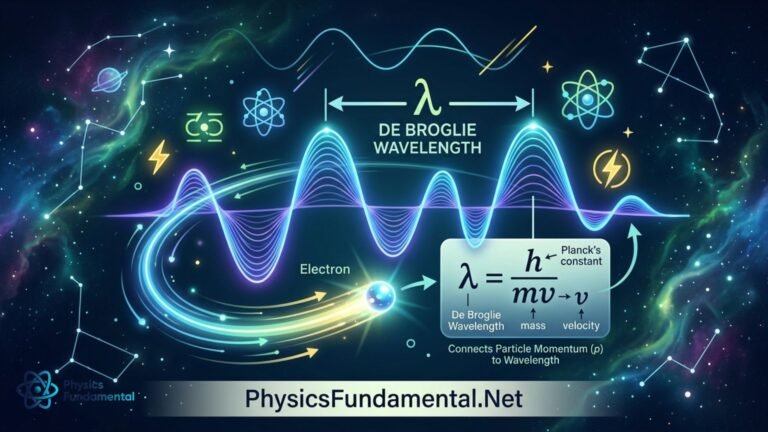
The relationship is:
c = fλ
where:
- f = frequency
- λ = wavelength
A higher frequency corresponds to a shorter wavelength for electromagnetic waves traveling in vacuum.
Why Was Measuring Light Speed So Difficult?
The challenge was not determining whether light moves.
The challenge was measuring an extremely short travel time.
For example, light travels approximately:
300 meters in one microsecond
and:
300 meters in one-millionth of a second.
Early clocks and human reaction times were nowhere near precise enough to measure such intervals over ordinary laboratory distances.
Scientists overcame this challenge by using:
- Astronomical distances
- Rotating wheels
- Rotating mirrors
- Long optical paths
- Precise mechanical instruments
- Electronic timing
- Lasers
Each generation of experiments improved the precision of the measurement.
Why the Speed of Light Is a Universal Limit
In relativity, the Speed of Light is more than simply the speed of electromagnetic radiation.
It acts as a fundamental limit for the transmission of information and causal influence in vacuum.
This leads to the idea that events separated by certain spacetime intervals cannot influence one another faster than light can travel between them.
The speed c therefore connects measurements of space and time.
Common Misconceptions About the Speed of Light
Misconception 1: Light Travels at 300,000 km/s Everywhere
The value of approximately 300,000 km/s refers specifically to vacuum.
Light propagates more slowly through ordinary materials.
Misconception 2: A Light-Year Is a Unit of Time
A light-year is a unit of distance.
It represents the distance light travels in one year.
Misconception 3: Scientists Measured the Exact Value in One Experiment
The modern value is the result of centuries of increasingly precise scientific work and eventually became an exact defined value.
Misconception 4: Light From the Sun Reaches Earth Instantly
It takes approximately 8 minutes 20 seconds for sunlight to reach Earth.
Misconception 5: The Speed of Light Is Just About Visible Light
The constant c applies to electromagnetic radiation in vacuum, including radio waves, microwaves, infrared, ultraviolet, X-rays, and gamma rays.
Key Speed of Light Formulas
The most useful equations include:
Speed, Distance, and Time
c = d/t
Therefore:
d = ct
and:
t = d/c
Wave Relationship
c = fλ
Refractive Index
n = c/v
Therefore:
v = c/n
Photon Energy
E = hf
Since:
f = c/λ
we also have:
E = hc/λ
Photon Momentum
p = h/λ
These equations connect light’s speed with distance, time, wavelength, frequency, energy, and momentum.
Frequently Asked Questions
What is the exact Speed of Light?
The Speed of Light in vacuum is exactly 299,792,458 meters per second.
Who first measured the Speed of Light?
Ole Rømer was the first to provide strong observational evidence and an estimate of a finite light speed using the eclipses of Jupiter’s moon Io.
How did Fizeau measure the Speed of Light?
Hippolyte Fizeau used a rotating toothed wheel and a distant mirror to measure the travel time of light over a known distance.
How long does sunlight take to reach Earth?
Sunlight takes approximately 8 minutes 20 seconds to travel from the Sun to Earth on average.
Is a light-year a measure of time?
No. A light-year is a unit of distance equal to the distance light travels through vacuum in one year.
Conclusion
The Speed of Light in vacuum is exactly 299,792,458 meters per second, making it one of the most important constants in science. Light moves so quickly that measuring its travel time was extremely difficult for early scientists.
The first major breakthrough came from astronomy. Ole Rømer used observations of Jupiter’s moon Io to show that light takes a measurable amount of time to travel through space. Later scientists, including Fizeau, Foucault, and Michelson, developed increasingly precise laboratory methods using rotating wheels and mirrors.
Today, the speed of light is an exact defined constant rather than simply an experimentally measured number. It forms the foundation of modern relativity, connects space and time, determines how we understand astronomical distances, and appears throughout physics in equations such as c = fλ and E = mc².
Understanding the Speed of Light therefore means understanding much more than how quickly light travels. It means understanding one of the fundamental limits and constants that shape our description of the universe.