Kinetic Theory of Gases: Powerful Pressure & Molecular Motion Guide 2026
What happens inside a gas when you cannot see its particles? Although gases look continuous at the macroscopic level, they are actually made of enormous numbers of tiny particles moving constantly in different directions. Their motion explains many familiar properties of gases, including pressure, temperature, and volume.
The kinetic theory of gases provides a microscopic explanation for how gases behave. Instead of treating pressure and temperature as abstract quantities, the theory connects them to the motion and collisions of individual molecules.
The theory is especially useful for understanding why increasing temperature can increase gas pressure, why gases expand when heated, and how molecular speed is related to temperature.
What Is the Kinetic Theory of Gases?
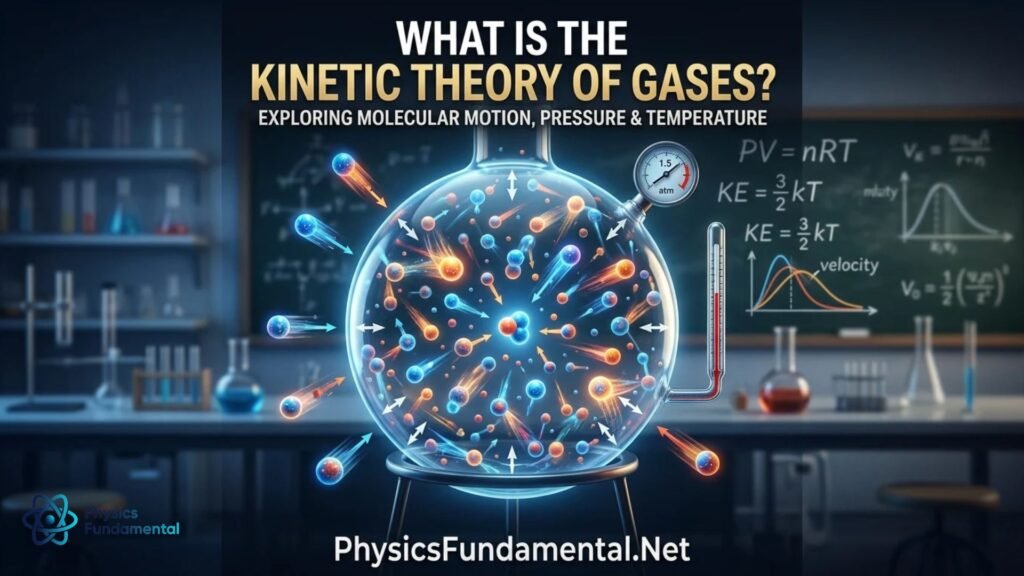
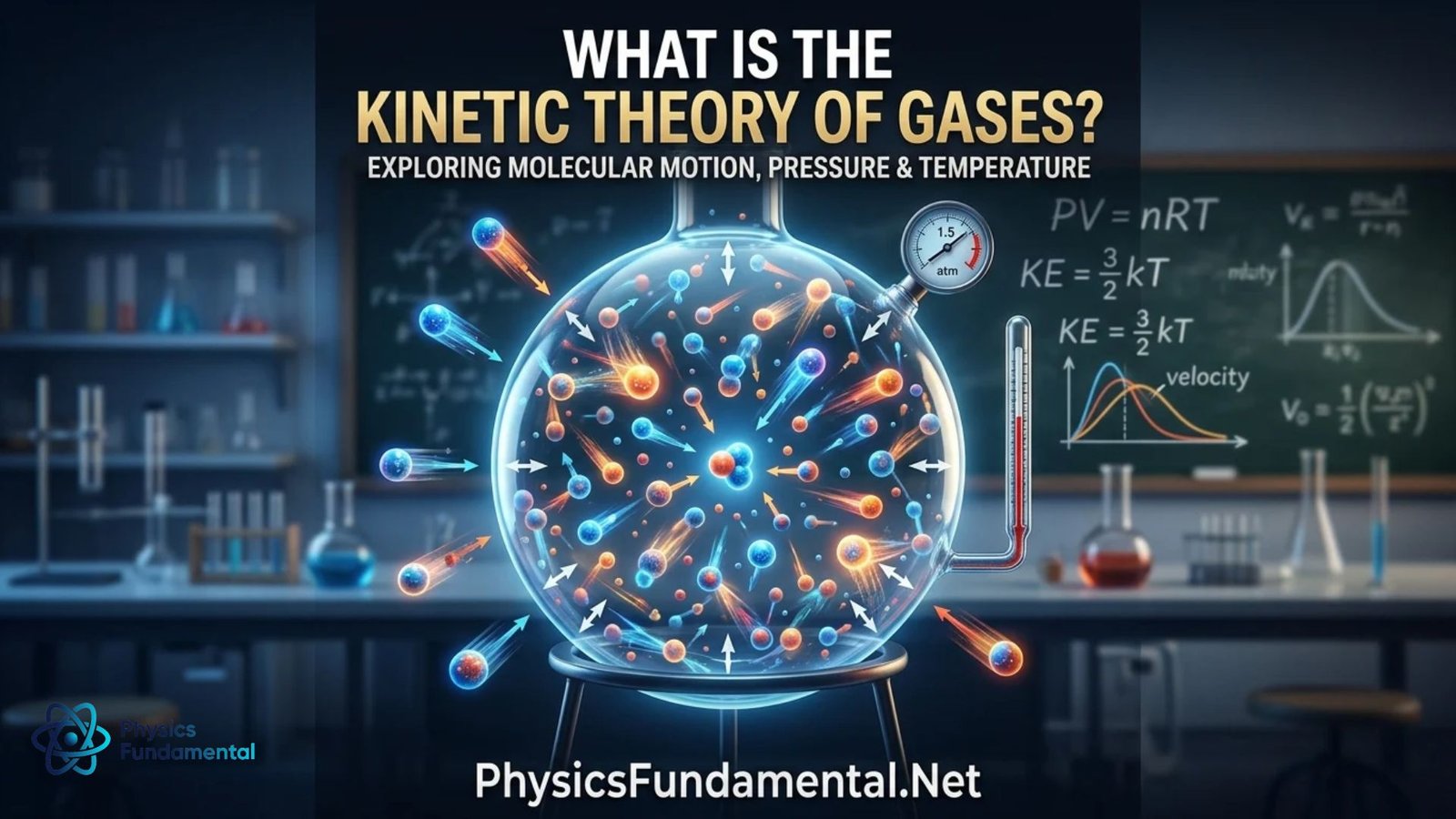
The kinetic theory of gases is a model that explains the macroscopic behavior of gases in terms of the microscopic motion of their particles.
According to the theory, a gas consists of a very large number of tiny particles that are in continuous random motion. These particles collide with one another and with the walls of their container.
The model connects observable quantities such as:
- Pressure
- Temperature
- Volume
- Density
with microscopic properties such as:
- Molecular mass
- Molecular speed
- Molecular motion
- Collision frequency
This connection is an important part of kinetic theory of gases and provides a foundation for understanding ideal gases.
Main Assumptions of the Kinetic Theory
The simplest version of the kinetic theory is based on several assumptions.
1. Gases Contain Many Particles
A gas contains a very large number of molecules or atoms.
The particles are small compared with the volume occupied by the gas.
2. Particles Are in Constant Motion
Gas particles are continuously moving in random directions.
They do not remain stationary unless the system reaches an idealized limiting condition.
3. Particles Move in Straight Lines Between Collisions
In the ideal-gas model, particles travel in straight paths until they collide with another particle or the walls of the container.
4. Collisions Are Elastic
The idealized model assumes that collisions between gas particles and container walls are perfectly elastic.
This means kinetic energy is conserved during the collision.
5. Intermolecular Forces Are Negligible
The particles are assumed to exert negligible attractive or repulsive forces on one another except during collisions.
This assumption works best for gases at relatively low pressures and sufficiently high temperatures.
6. Particle Volume Is Negligible
The actual volume occupied by the gas particles is assumed to be very small compared with the total volume of the container.
These assumptions define the ideal gas model.
How Molecular Motion Creates Pressure
One of the most important ideas in kinetic theory is that gas pressure is caused by collisions of particles with the walls of a container.
Imagine a gas inside a sealed box.
The molecules move in random directions. When a molecule hits a wall, it changes momentum.
According to Newton’s laws, the change in momentum produces a force on the wall.
Billions of collisions occur every second, producing a measurable average force.
Pressure is defined as:
P = F/A
where:
- P = pressure
- F = force
- A = area
Therefore, the microscopic collisions of molecules produce the macroscopic pressure that we measure.
Molecular Motion and Temperature
Temperature is closely related to the average kinetic energy of gas particles.
For an ideal gas, the average translational kinetic energy of a particle is:
KEₐᵥ = 3/2 kBT
where:
- kB = Boltzmann constant
- T = absolute temperature in kelvin
This equation shows that increasing the absolute temperature increases the average kinetic energy of the particles.
As temperature rises, molecules generally move faster on average.
As temperature falls, their average translational kinetic energy decreases.
Why Absolute Temperature Is Important
The kinetic theory uses temperature measured in kelvin, not degrees Celsius.
The conversion is:
T(K) = T(°C) + 273.15
For example:
27°C = 300.15 K
Using kelvin is important because temperature in kinetic theory is directly related to molecular kinetic energy.
Gas Pressure and Temperature
Consider a fixed amount of gas inside a rigid container.
If the temperature increases, the molecules gain average kinetic energy and move faster.
The faster molecules collide with the walls more frequently and with greater momentum changes.
As a result, the pressure increases if the volume remains constant.
This relationship is described by:
P/T = constant
for a fixed amount of gas at constant volume.
This is commonly known as Gay-Lussac’s law.
Gas Pressure and Volume
Now imagine a gas at constant temperature.
If the volume of the container decreases, the particles have less space in which to move.
They strike the walls more frequently.
As a result, pressure increases.
This relationship is described by Boyle’s law:
PV = constant
for a fixed amount of gas at constant temperature.
Therefore:
P₁V₁ = P₂V₂
This demonstrates how microscopic molecular motion explains a macroscopic gas law.
The Ideal Gas Equation
The kinetic theory is closely connected to the ideal gas equation:
PV = nRT
where:
- P = pressure
- V = volume
- n = amount of gas in moles
- R = universal gas constant
- T = absolute temperature
Another microscopic form is:
PV = NkBT
where:
- N = number of particles
- kB = Boltzmann constant
- T = absolute temperature
The two equations are equivalent because:
R = NₐkB
where Nₐ is Avogadro’s constant.
Deriving Pressure From Molecular Motion
Kinetic theory provides a microscopic expression for pressure:
P = 1/3 ρvᵣₘₛ²
where:
- P = pressure
- ρ = gas density
- vᵣₘₛ = root-mean-square molecular speed
Since:
ρ = Nm/V
we can write:
P = 1/3 (Nm/V)vᵣₘₛ²
Multiplying by volume:
PV = 1/3 Nmvᵣₘₛ²
This equation directly connects pressure and volume with the microscopic motion of gas molecules.
Root-Mean-Square Speed
Gas molecules do not all move at exactly the same speed.
Some molecules move relatively slowly, while others move much faster.
A useful measure of molecular speed is the root-mean-square speed:
vᵣₘₛ = √(3kBT/m)
where:
- kB = Boltzmann constant
- T = absolute temperature
- m = mass of one particle
This equation shows that molecular speed increases with temperature.
It also shows that, at the same temperature, lighter molecules have a greater typical speed than heavier molecules.
You May Like to Read: Quantum Numbers Explained: Powerful n, l, mₗ, mₛ Guide 2026
Example: Molecular Speed and Temperature
Suppose the temperature of an ideal gas increases from 300 K to 600 K.
Because:
vᵣₘₛ ∝ √T
the ratio of the new speed to the original speed is:
v₂/v₁ = √(T₂/T₁)
Therefore:
v₂/v₁ = √(600/300)
v₂/v₁ = √2
v₂ ≈ 1.41v₁
So doubling the absolute temperature increases the root-mean-square speed by a factor of approximately 1.41, not 2.
Maxwell-Boltzmann Distribution
At a particular temperature, gas molecules do not all have the same kinetic energy.
Instead, their speeds follow a statistical distribution known as the Maxwell-Boltzmann distribution.
The distribution shows that:
- Some molecules have low speeds.
- Many molecules have speeds around a typical value.
- A smaller number have very high speeds.
When temperature increases, the distribution shifts toward higher speeds and becomes broader.
This explains why gas molecules at the same temperature can still have different speeds.
What Happens When a Gas Is Heated?
When a gas is heated, energy is transferred to the gas.
The average kinetic energy of its particles increases.
Depending on the conditions, this can produce different effects.
Constant Volume
If the volume remains fixed, the pressure increases.
Constant Pressure
If the pressure remains constant, the gas can expand.
Flexible Container
If the gas is inside a flexible container, heating can cause the container to expand.
These behaviors can be understood using molecular motion and the ideal gas laws.
Diffusion and Molecular Motion
Kinetic theory also explains diffusion, the spontaneous mixing of particles.
Imagine opening a bottle of perfume in one corner of a room.
The gas molecules from the perfume spread throughout the room because they are in constant random motion.
No external force is required to make the molecules spread.
The process results from their microscopic motion and repeated collisions.
Why Do Gases Fill Their Containers?
A gas does not maintain a fixed shape or volume because its particles are constantly moving and widely separated compared with particles in liquids and solids.
When placed in a container, gas particles move throughout the available space.
As a result, the gas expands until it occupies the entire container.
This is one of the defining properties of gases.
Kinetic Theory of Gases vs Ideal Gas
These terms are related but not identical.
The kinetic theory of gases is a microscopic model that explains gas behavior using particle motion.
An ideal gas is a theoretical gas that follows the ideal gas equation and closely satisfies the assumptions of the idealized kinetic model.
Real gases can behave approximately like ideal gases under certain conditions.
At high pressures or low temperatures, intermolecular interactions and molecular volume can become important, causing deviations from ideal behavior.
Real Gases and Limitations
The kinetic theory of ideal gases is extremely useful, but it is a model.
Real gas particles do have finite size and interact with one another.
The ideal approximation becomes less accurate when:
- Pressure is very high.
- Temperature is very low.
- The gas is close to condensation.
- Intermolecular forces become significant.
More advanced models, such as the van der Waals equation, account for some of these effects.
Applications of Kinetic Theory
The kinetic theory of gases has many applications in science and engineering.
Engines
The behavior of gases inside engines depends on pressure, temperature, volume, and molecular motion.
Refrigeration
Refrigeration systems involve gases and phase changes, making molecular behavior important for understanding how heat is transferred.
Atmospheric Science
The atmosphere consists of gas molecules whose motion contributes to pressure, temperature, diffusion, and other atmospheric properties.
Industrial Gas Systems
Gas storage, pipelines, compressors, and pressure systems all depend on the relationships between temperature, pressure, volume, and molecular motion.
Space Science
Kinetic theory helps scientists understand thin gases and plasmas in planetary atmospheres and interstellar environments.
Common Misconceptions
Gas Particles Are Stationary
They are not. Gas particles are in continuous random motion.
Higher Temperature Means Every Molecule Moves Faster
Temperature increases the average kinetic energy. Individual molecules still have a range of speeds.
Gas Pressure Is a Separate Property From Molecular Motion
At the microscopic level, pressure results from molecular collisions with container walls.
All Gases Behave Perfectly Like Ideal Gases
Real gases only approximate ideal behavior under appropriate conditions.
Molecules Stop Moving at 0°C
No. Absolute zero is 0 K, equal to approximately −273.15°C. Also, quantum mechanics means the behavior of matter near absolute zero requires more careful treatment than simply saying all motion completely stops.
Quick Formula Summary
Important equations from the kinetic theory of gases include:
PV = nRT
PV = NkBT
KEₐᵥ = 3/2 kBT
P = 1/3 ρvᵣₘₛ²
vᵣₘₛ = √(3kBT/m)
For a fixed amount of gas:
P₁V₁ = P₂V₂ when temperature is constant.
And at constant volume:
P₁/T₁ = P₂/T₂
These equations connect the measurable properties of gases with the microscopic behavior of their particles.
Frequently Asked Questions
What is the kinetic theory of gases?
It is a model that explains gas behavior by considering the constant random motion and collisions of microscopic particles.
How does molecular motion create gas pressure?
Gas molecules collide with the walls of their container. These collisions transfer momentum and produce an average force, which creates pressure.
How does temperature affect molecular motion?
For an ideal gas, increasing temperature increases the average translational kinetic energy of its particles.
What is the ideal gas equation?
The ideal gas equation is PV = nRT, where pressure, volume, amount of gas, and absolute temperature are related.
Do all gas molecules move at the same speed?
No. Gas molecules have a range of speeds. The Maxwell-Boltzmann distribution describes how those speeds are distributed.
Conclusion
The kinetic theory of gases provides a powerful microscopic explanation for the behavior of gases. It shows that pressure comes from molecular collisions, while temperature is directly related to the average translational kinetic energy of gas particles.
The theory also explains important gas laws and relationships, including PV = nRT, Boyle’s law, and the connection between temperature and molecular speed. Although the ideal-gas model makes simplifying assumptions, it provides an essential foundation for understanding gases in physics, chemistry, engineering, and atmospheric science.