Momentum Conservation: Powerful Elastic vs Inelastic Collisions 2026
When two objects collide, their speeds and directions can change dramatically. A fast-moving ball can transfer motion to another ball, two vehicles can move together after impact, or particles can scatter in different directions. Despite these changes, there is a fundamental quantity that remains constant in an isolated system: momentum.
The principle of conservation of momentum explains why the total momentum before a collision equals the total momentum after it, provided no significant external force acts on the system. This principle is used to analyze everything from everyday collisions to rocket propulsion and particle interactions.
Collisions are commonly divided into elastic and inelastic collisions. Momentum is conserved in both types when the system is isolated, but kinetic energy behaves differently. Understanding this difference is essential for solving collision problems in physics.
What Is Momentum?
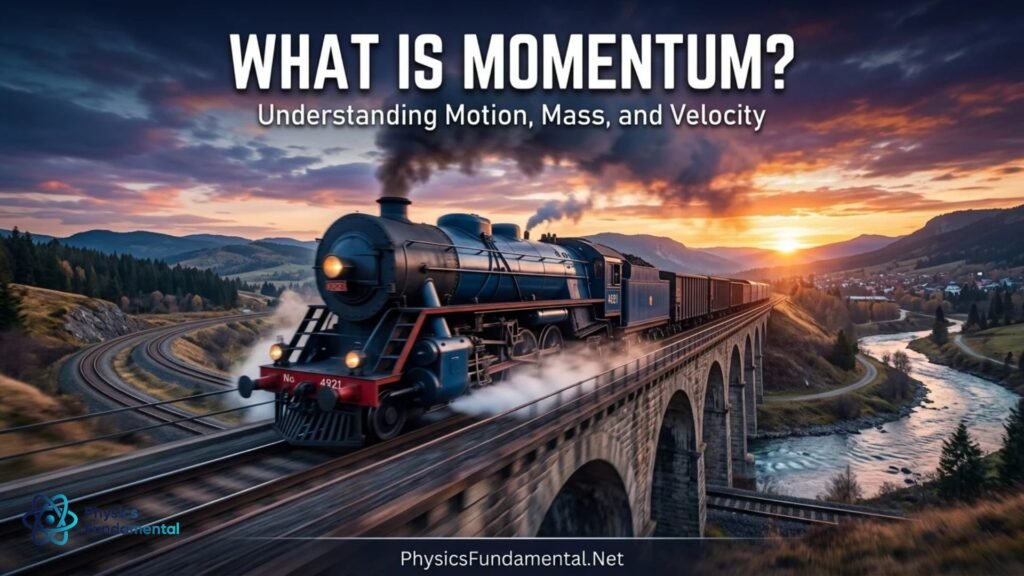
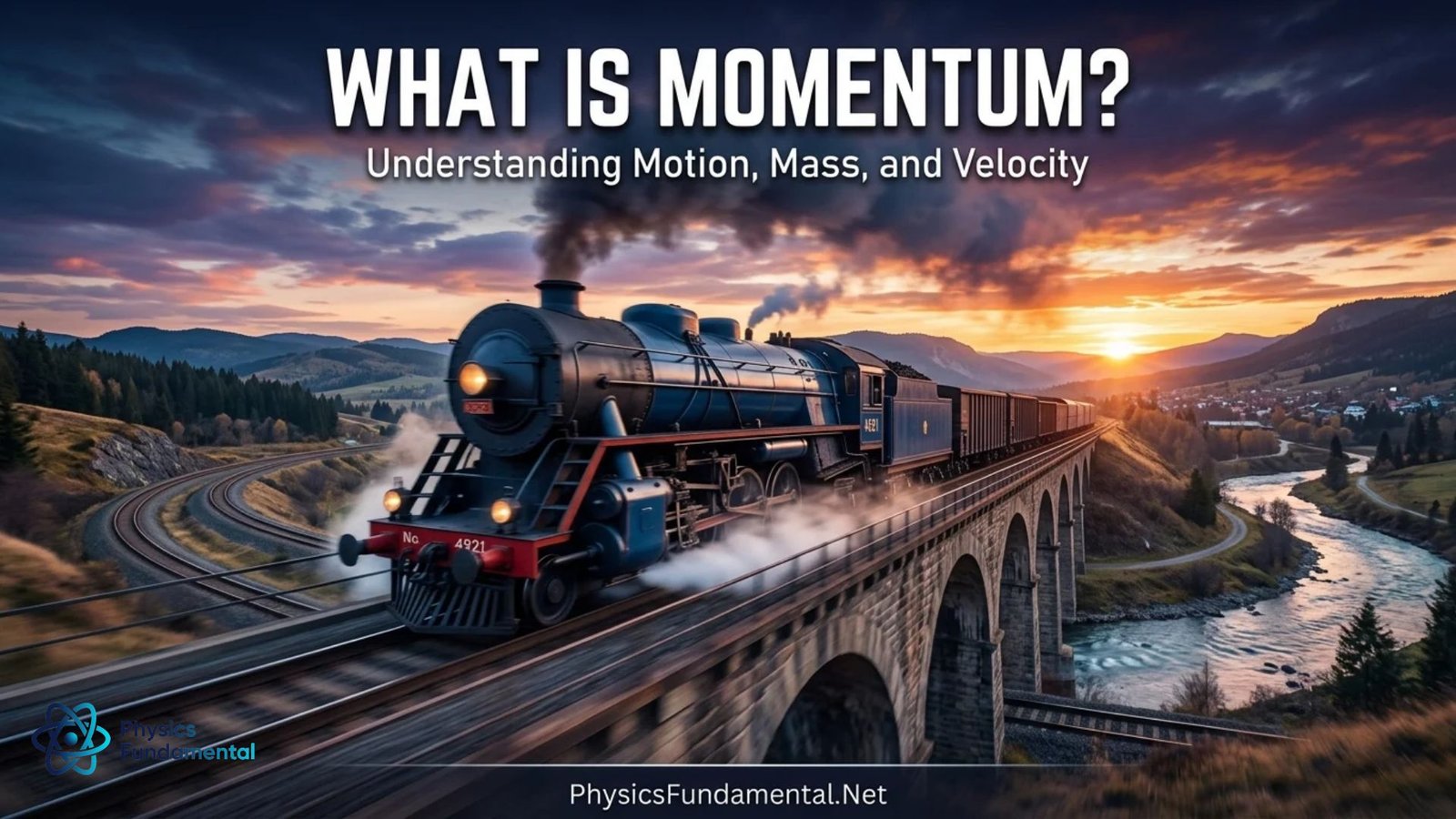
Momentum is a measure of an object’s quantity of motion. It depends on both the object’s mass and velocity.
The formula for momentum is:
p = mv
where:
- p = momentum
- m = mass
- v = velocity
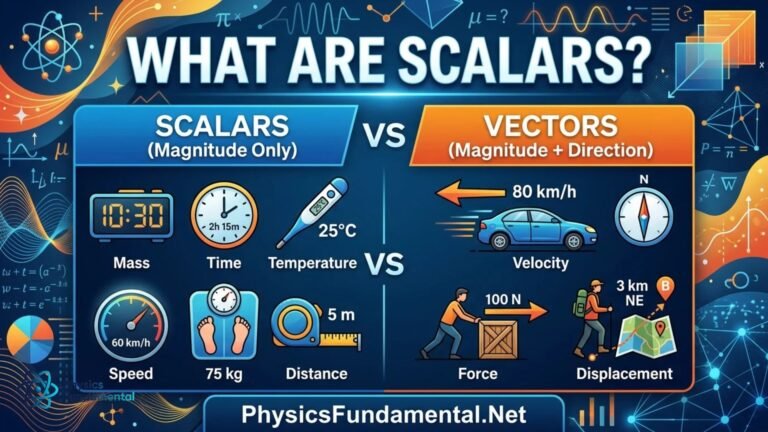
Momentum is a vector quantity, which means it has both magnitude and direction.
The SI unit of momentum is:
kg·m/s
For example, a 5 kg object moving at 4 m/s has momentum:
p = mv
p = 5 × 4
p = 20 kg·m/s
If the object changes direction, its momentum also changes direction.
What Is Conservation of Momentum?
The law of conservation of momentum states that the total momentum of an isolated system remains constant.
In simple terms:
Total momentum before collision = Total momentum after collision
For two objects:
m₁u₁ + m₂u₂ = m₁v₁ + m₂v₂
where:
- m₁ = mass of object 1
- m₂ = mass of object 2
- u₁ = initial velocity of object 1
- u₂ = initial velocity of object 2
- v₁ = final velocity of object 1
- v₂ = final velocity of object 2
This principle is a central part of momentum conservation and is especially useful when analyzing collisions and interactions between objects.
Why Is Momentum Conserved?
Momentum is conserved when the net external force acting on a system is zero or negligible.
Newton’s second law can be written in terms of momentum as:
F = Δp/Δt
Therefore:
Δp = FΔt
If the net external force is zero, the total momentum does not change.
During a collision, the objects exert forces on each other. These internal forces are equal and opposite according to Newton’s third law. As a result, momentum lost by one object is gained by the other.
For example, if one moving ball hits another stationary ball, the first ball may slow down while the second ball begins moving. The momentum has been transferred between the objects rather than destroyed.
Momentum Conservation in a Collision
Consider two objects moving along a straight line.
Before the collision:
Total momentum = m₁u₁ + m₂u₂
After the collision:
Total momentum = m₁v₁ + m₂v₂
Therefore:
m₁u₁ + m₂u₂ = m₁v₁ + m₂v₂
This equation can be used to calculate an unknown velocity, mass, or other quantity.
It is important to assign directions consistently. If motion to the right is positive, motion to the left should be negative.
What Is an Elastic Collision?
An elastic collision is a collision in which both momentum and total kinetic energy are conserved.
For momentum:
Total momentum before = Total momentum after
For kinetic energy:
Total kinetic energy before = Total kinetic energy after
The kinetic energy of an object is:
KE = ½mv²
Therefore, for an elastic collision:
½m₁u₁² + ½m₂u₂² = ½m₁v₁² + ½m₂v₂²
Ideal elastic collisions are common in simplified physics problems. In real-world situations, perfectly elastic collisions are rare because some energy is usually converted into sound, heat, deformation, or other forms.
Example of an Elastic Collision
Imagine a 2 kg cart moving at 6 m/s toward a stationary 2 kg cart. Suppose the collision is perfectly elastic.
Initially:
m₁ = 2 kg
u₁ = 6 m/s
m₂ = 2 kg
u₂ = 0 m/s
Because the masses are equal and the collision is perfectly elastic, the moving cart transfers its velocity to the stationary cart.
After the collision:
v₁ = 0 m/s
v₂ = 6 m/s
Initial momentum:
pᵢ = (2 × 6) + (2 × 0)
pᵢ = 12 kg·m/s
Final momentum:
p𝒇 = (2 × 0) + (2 × 6)
p𝒇 = 12 kg·m/s
Momentum is conserved.
Initial kinetic energy:
KEᵢ = ½(2)(6²)
KEᵢ = 36 J
Final kinetic energy:
KE𝒇 = ½(2)(6²)
KE𝒇 = 36 J
Kinetic energy is also conserved.
What Is an Inelastic Collision?
An inelastic collision is a collision in which momentum is conserved but kinetic energy is not conserved.
Some of the initial kinetic energy is transformed into other forms of energy, such as:
- Heat
- Sound
- Deformation
- Internal energy
- Fracture or damage
The total energy of the system is still conserved, but kinetic energy alone is not.
Therefore:
Momentum is conserved.
Kinetic energy is not conserved.
This is the key difference between elastic and inelastic collisions.
Perfectly Inelastic Collision
A perfectly inelastic collision occurs when two objects collide and stick together afterward.
Because the objects move together after the collision, they have the same final velocity.
The momentum equation becomes:
m₁u₁ + m₂u₂ = (m₁ + m₂)v
Therefore:
v = (m₁u₁ + m₂u₂)/(m₁ + m₂)
This is one of the most useful equations for collision problems.
Example of a Perfectly Inelastic Collision
Suppose a 4 kg object moves at 5 m/s and collides with a stationary 6 kg object. They stick together.
Given:
m₁ = 4 kg
u₁ = 5 m/s
m₂ = 6 kg
u₂ = 0 m/s
Using conservation of momentum:
m₁u₁ + m₂u₂ = (m₁ + m₂)v
Substitute:
(4)(5) + (6)(0) = (4 + 6)v
20 = 10v
Therefore:
v = 2 m/s
The two objects move together at 2 m/s after the collision.
Elastic vs Inelastic Collisions
The main difference can be summarized as follows:
| Feature | Elastic Collision | Inelastic Collision |
|---|---|---|
| Momentum conserved | Yes | Yes |
| Kinetic energy conserved | Yes | No |
| Total energy conserved | Yes | Yes |
| Objects deform | Ideally no permanent deformation | Often some deformation |
| Sound/heat produced | Ideally negligible | Often produced |
| Objects stick together | No | Sometimes |
| Example | Idealized billiard-ball collision | Vehicle collision |
The distinction is important: momentum conservation applies to both, while kinetic-energy conservation distinguishes an ideal elastic collision from an inelastic one.
How to Solve Collision Problems
A reliable approach is to follow a few steps.
Step 1: Identify the Objects
Write down the mass of each object.
For example:
m₁ = 2 kg
m₂ = 3 kg
Step 2: Identify Initial Velocities
Determine the velocity of each object before the collision.
Remember that direction matters.
If right is positive and left is negative, a velocity toward the left must be given a negative value.
You May Like to Read: Lens and Mirror Equation: Powerful Formula, Examples & Facts 2026
Step 3: Identify the Collision Type
Ask whether the collision is:
- Elastic
- Inelastic
- Perfectly inelastic
If the objects stick together, it is perfectly inelastic.
Step 4: Apply Momentum Conservation
Use:
m₁u₁ + m₂u₂ = m₁v₁ + m₂v₂
If the objects stick together:
m₁u₁ + m₂u₂ = (m₁ + m₂)v
Step 5: Use Kinetic Energy When Appropriate
For a perfectly elastic collision, kinetic energy is also conserved.
Use:
½m₁u₁² + ½m₂u₂² = ½m₁v₁² + ½m₂v₂²
For an ordinary inelastic collision, do not assume kinetic energy is conserved.
Why Direction Matters in Momentum Problems
Momentum is a vector, so direction cannot be ignored.
Suppose a 2 kg ball moves to the right at 5 m/s.
Its momentum is:
p = 2 × 5 = 10 kg·m/s
If it moves to the left at 5 m/s, then:
p = 2 × (−5)
p = −10 kg·m/s
The negative sign indicates direction.
This becomes especially important when two objects move toward each other before a collision.
Momentum Conservation in Two Dimensions
Momentum conservation also applies when objects move in more than one dimension.
Instead of treating momentum as one quantity, it is separated into components.
For the x-direction:
Σpₓ before = Σpₓ after
For the y-direction:
Σpᵧ before = Σpᵧ after
This is useful for analyzing collisions in which objects move away from each other at angles.
For example, if two objects collide and scatter in different directions, conservation of momentum can be applied independently along the horizontal and vertical axes.
Where Is Momentum Conservation Used?
The conservation of momentum has many practical applications.
Vehicle Collisions
Investigators can use momentum principles to analyze the motion of vehicles before and after collisions. Measurements of mass, velocity, and direction can help reconstruct aspects of an impact.
Sports
When players collide or balls strike each other, momentum is transferred between objects. The same principles help explain impacts in sports such as billiards, football, and baseball.
Rocket Propulsion
A rocket moves forward because gases are expelled in the opposite direction. The momentum of the exhaust and rocket are related through momentum conservation.
Recoil
When a gun or another object launches a projectile, the projectile moves forward while the launcher experiences recoil in the opposite direction. The total momentum of an isolated system remains conserved.
Particle Physics
Momentum conservation is fundamental when analyzing interactions between particles. Scientists use it to compare the motion of particles before and after collisions.
Momentum vs Kinetic Energy
Momentum and kinetic energy are related to motion, but they are not the same quantity.
Momentum:
p = mv
Kinetic energy:
KE = ½mv²
Momentum depends linearly on velocity, while kinetic energy depends on the square of velocity.
This difference is why a collision can conserve momentum while losing kinetic energy.
For example, when two objects stick together, some of their kinetic energy may become heat, sound, or deformation energy. However, the total momentum can still remain unchanged.
Common Mistakes in Collision Problems
Assuming Kinetic Energy Is Always Conserved
Kinetic energy is conserved in an ideal elastic collision, but not in a general inelastic collision.
Momentum conservation is the principle that applies to both types when the system is isolated.
Ignoring Direction
Do not use only the speed. Velocity includes direction, and momentum depends on velocity.
Forgetting That Stuck Objects Share One Velocity
In a perfectly inelastic collision, the objects move together afterward. They therefore have the same final velocity.
Using Different Units
Mass should normally be in kilograms and velocity in meters per second when calculating momentum in SI units.
Ignoring External Forces
Momentum conservation requires an isolated system or a situation where external impulse is negligible. Significant external forces can change the total momentum of the system.
Quick Summary
The fundamental momentum equation is:
p = mv
For two colliding objects:
m₁u₁ + m₂u₂ = m₁v₁ + m₂v₂
For a perfectly inelastic collision:
m₁u₁ + m₂u₂ = (m₁ + m₂)v
For an elastic collision, both momentum and kinetic energy are conserved:
m₁u₁ + m₂u₂ = m₁v₁ + m₂v₂
and
½m₁u₁² + ½m₂u₂² = ½m₁v₁² + ½m₂v₂²
The central idea is simple: momentum is conserved in an isolated system, while kinetic energy is conserved only in an elastic collision.
Frequently Asked Questions
Is momentum conserved in every collision?
Momentum is conserved when the collision system is isolated or when the net external impulse is negligible.
What is the difference between elastic and inelastic collisions?
Both conserve momentum, but an elastic collision also conserves total kinetic energy. In an inelastic collision, some kinetic energy changes into other forms.
What happens in a perfectly inelastic collision?
The objects stick together after the collision and move with one common velocity.
Why is kinetic energy not conserved in an inelastic collision?
Some kinetic energy is converted into heat, sound, deformation, and other forms of energy, although total energy remains conserved.
What is the formula for conservation of momentum?
For two objects, the formula is m₁u₁ + m₂u₂ = m₁v₁ + m₂v₂.
Conclusion
The conservation of momentum is one of the most useful principles for understanding collisions and interactions. It states that the total momentum of an isolated system remains constant, even when individual objects change their velocities.
The major distinction between collision types is kinetic energy. In an elastic collision, both momentum and kinetic energy are conserved. In an inelastic collision, momentum is conserved but some kinetic energy is transformed into heat, sound, deformation, or other forms of energy.
Once you understand momentum, direction, sign conventions, and the difference between elastic and inelastic collisions, a wide range of physics problems become much easier to analyze.