SUVAT Equations Explained: Powerful Motion Formulas 2026
Motion problems can look complicated when several quantities are changing at the same time. An object may have an initial velocity, accelerate for several seconds, travel a certain distance, and reach a different final velocity. The SUVAT equations provide a simple way to connect these quantities when acceleration is constant.
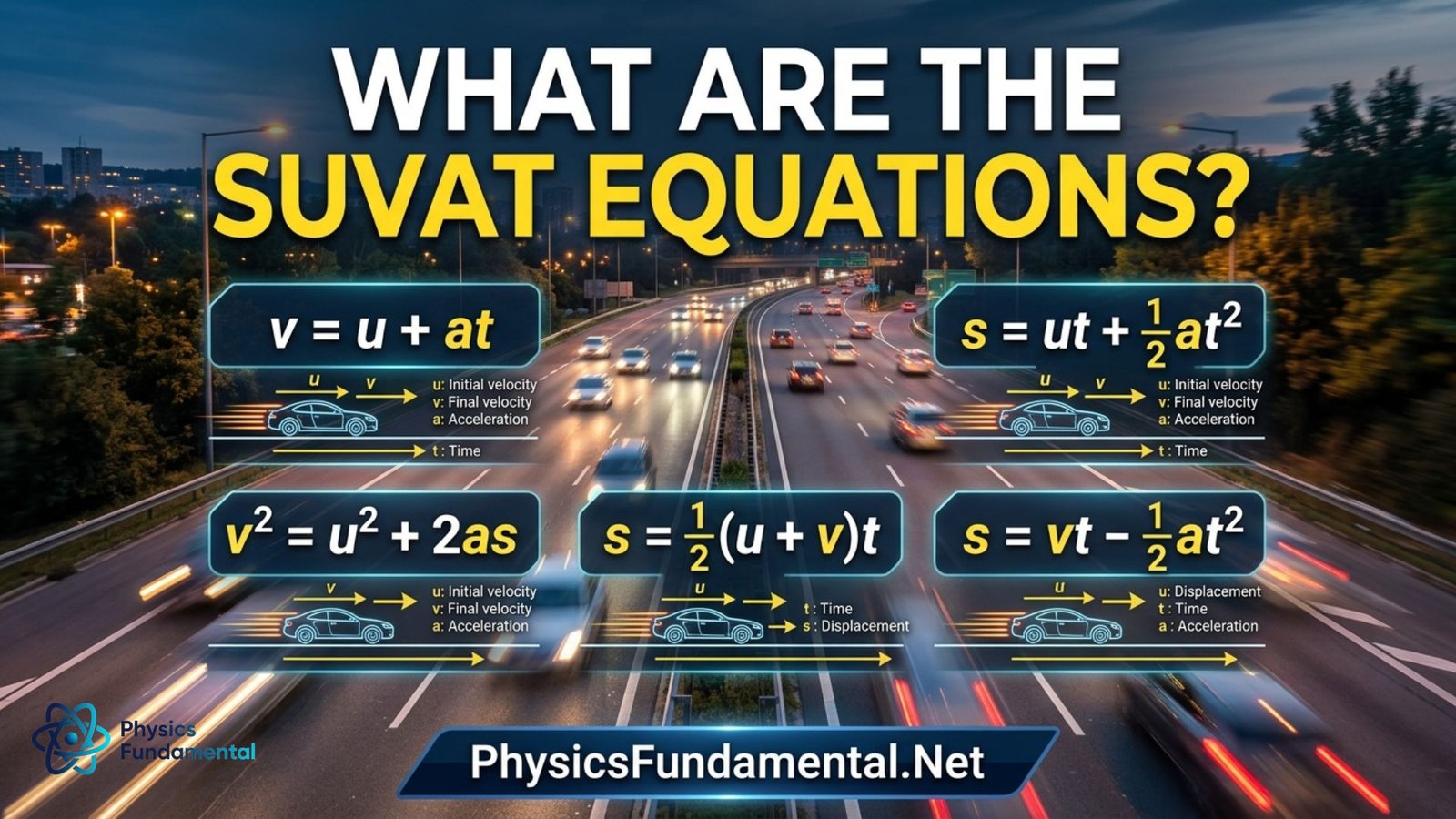
The name SUVAT comes from the five variables used in the equations: s for displacement, u for initial velocity, v for final velocity, a for acceleration, and t for time. These equations are also called the kinematic equations and are widely used in physics to solve problems involving uniformly accelerated motion.
Whether you are studying a car accelerating on a straight road, an object in free fall, or a projectile’s vertical motion, knowing which SUVAT equation to use can make the calculation much easier.
What Are the SUVAT Equations?

The SUVAT equations are five equations used to describe motion with constant acceleration.
The five variables are:
- s = displacement
- u = initial velocity
- v = final velocity
- a = acceleration
- t = time
The five standard equations are:
v = u + at
s = ut + ½at²
s = vt − ½at²
s = ½(u + v)t
v² = u² + 2as
These equations allow you to calculate an unknown quantity when enough other information is known.
What Does SUVAT Stand For?
The word SUVAT is simply an acronym.
| Letter | Quantity | SI Unit |
|---|---|---|
| S | Displacement | m |
| U | Initial velocity | m/s |
| V | Final velocity | m/s |
| A | Acceleration | m/s² |
| T | Time | s |
The important point is that s represents displacement rather than simply distance.
Displacement includes direction, so signs matter when solving SUVAT problems.
The First SUVAT Equation: v = u + at
The first equation is:
v = u + at
It connects:
- Initial velocity
- Final velocity
- Acceleration
- Time
This equation is particularly useful when displacement is not needed.
Example
A car starts at 5 m/s and accelerates at 3 m/s² for 4 seconds. Find its final velocity.
Given:
u = 5 m/s
a = 3 m/s²
t = 4 s
Use:
v = u + at
Substitute:
v = 5 + (3)(4)
v = 17 m/s
Therefore, the final velocity is:
17 m/s
The Second SUVAT Equation: s = ut + ½at²
The second equation is:
s = ut + ½at²
It connects:
- Displacement
- Initial velocity
- Acceleration
- Time
It is useful when you know initial velocity, acceleration, and time and want to find displacement.
Example
A car travels at an initial velocity of 10 m/s and accelerates at 2 m/s² for 5 seconds. Find its displacement.
Given:
u = 10 m/s
a = 2 m/s²
t = 5 s
Use:
s = ut + ½at²
Substitute:
s = (10)(5) + ½(2)(5²)
s = 50 + 25
s = 75 m
The displacement is:
75 m
The Third SUVAT Equation: s = vt − ½at²
The third equation is:
s = vt − ½at²
It uses:
- Displacement
- Final velocity
- Acceleration
- Time
This version is useful when the final velocity is known instead of the initial velocity.
Example
An object has a final velocity of 20 m/s after accelerating at 4 m/s² for 3 seconds. Find its displacement.
Use:
s = vt − ½at²
Substitute:
s = (20)(3) − ½(4)(3²)
s = 60 − 18
s = 42 m
Therefore:
s = 42 m
The Fourth SUVAT Equation: s = ½(u + v)t
The fourth equation is:
s = ½(u + v)t
This equation uses the average velocity:
Average velocity = (u + v)/2
Therefore:
s = average velocity × time
This equation is useful when you know initial velocity, final velocity, and time.
Example
A vehicle increases its velocity from 8 m/s to 20 m/s in 6 seconds. Find its displacement.
Use:
s = ½(u + v)t
Substitute:
s = ½(8 + 20)(6)
s = ½(28)(6)
s = 84 m
The displacement is:
84 m
The Fifth SUVAT Equation: v² = u² + 2as
The fifth equation is:
v² = u² + 2as
This equation is especially useful when time is not given.
It connects:
- Final velocity
- Initial velocity
- Acceleration
- Displacement
Example
A car starts at 10 m/s and accelerates at 3 m/s² over a distance of 50 m. Find its final velocity.
Given:
u = 10 m/s
a = 3 m/s²
s = 50 m
Use:
v² = u² + 2as
Substitute:
v² = 10² + 2(3)(50)
v² = 100 + 300
v² = 400
Therefore:
v = 20 m/s
The final velocity is:
20 m/s
How to Choose the Correct SUVAT Equation
Choosing the correct equation is often the hardest part of a SUVAT problem.
A useful method is to list all the known quantities first.
For example:
u = ?
v = 20 m/s
a = 3 m/s²
s = 50 m
t = ?
You then choose an equation containing the known values and the unknown you need.
For example:
v² = u² + 2as
contains v, u, a, s.
If all except u are known, it may be appropriate.
A Simple SUVAT Equation Table
| Equation | Best Used When |
|---|---|
| v = u + at | Displacement is not needed |
| s = ut + ½at² | Final velocity is not known |
| s = vt − ½at² | Initial velocity is not known |
| s = ½(u + v)t | Initial and final velocities are known |
| v² = u² + 2as | Time is not known |
The best equation is usually the one containing the quantities you already know and the quantity you need to calculate.
Worked Example: Full SUVAT Problem
A train is traveling at 12 m/s and accelerates uniformly at 2 m/s² for 8 seconds.
Find:
- Its final velocity
- Its displacement
Step 1: Identify the variables
u = 12 m/s
a = 2 m/s²
t = 8 s
v = ?
s = ?
Step 2: Find final velocity
Use:
v = u + at
v = 12 + (2)(8)
v = 28 m/s
Step 3: Find displacement
Use:
s = ut + ½at²
s = (12)(8) + ½(2)(8²)
s = 96 + 64
s = 160 m
Therefore:
Final velocity = 28 m/s
Displacement = 160 m
SUVAT Equations and Free Fall
The SUVAT equations are particularly useful for objects falling under gravity.
Near Earth’s surface, ignoring air resistance:
a = g ≈ 9.8 m/s²
Depending on the direction you choose as positive, acceleration due to gravity can be:
+9.8 m/s²
or:
−9.8 m/s²
The sign depends entirely on your chosen coordinate system.
Worked Example: Falling Object
An object is dropped from rest and falls for 3 seconds. Ignore air resistance. Find its final velocity.
Since the object is dropped:
u = 0
Take downward as positive:
a = 9.8 m/s²
t = 3 s
Use:
v = u + at
v = 0 + (9.8)(3)
v = 29.4 m/s
The final velocity is:
29.4 m/s downward
Finding Distance Fallen
Using the same example:
u = 0
a = 9.8 m/s²
t = 3 s
Use:
s = ut + ½at²
s = (0)(3) + ½(9.8)(3²)
s = 4.9 × 9
s = 44.1 m
The object falls approximately:
44.1 m
SUVAT and Projectile Motion
SUVAT equations can also be used for the vertical component of projectile motion.
For a projectile:
uᵧ = u sinθ
and:
aᵧ = −g
The vertical motion can then be analyzed using the SUVAT equations.
For example:
vᵧ = uᵧ − gt
and:
y = uᵧt − ½gt²
The horizontal component has constant velocity when air resistance is ignored:
x = uₓt
This separation of horizontal and vertical motion is one of the most useful ideas in projectile problems.
Why Is Acceleration Constant?
The SUVAT equations only apply when acceleration is constant.
For example, near Earth’s surface, gravitational acceleration is approximately constant:
g = 9.8 m/s²
This makes the equations suitable for many basic free-fall problems.
However, if acceleration changes significantly with time, the standard SUVAT equations cannot be applied directly over the entire motion.
You May Like to Read: Thermal Energy Explained: Powerful Q = mcΔT Formula & Examples 2026
Displacement vs Distance
One common source of mistakes is confusing displacement with distance.
Distance is the total path length traveled.
Displacement is the change in position from the starting point to the ending point.
For example, if you walk 10 m forward and then 10 m backward:
Distance = 20 m
but:
Displacement = 0 m
SUVAT equations use displacement, represented by s.
Velocity vs Speed
SUVAT problems also use velocity rather than simply speed.
Velocity includes direction.
For example:
+10 m/s
and:
−10 m/s
have the same speed but opposite velocities.
The sign becomes especially important in vertical motion.
Acceleration and Signs
Acceleration is also directional.
If upward is positive, gravity is:
a = −9.8 m/s²
If downward is positive, gravity is:
a = +9.8 m/s²
Either convention works as long as you use it consistently.
A useful strategy is to choose a positive direction at the beginning of the problem and keep that choice throughout.
Deriving the First SUVAT Equation
The first equation comes directly from the definition of constant acceleration.
Acceleration is:
a = Δv/Δt
Therefore:
a = (v − u)/t
Multiply by t:
at = v − u
Rearrange:
v = u + at
So the first SUVAT equation follows directly from the definition of acceleration.
Deriving the Fourth SUVAT Equation
For constant acceleration, average velocity is:
average velocity = (u + v)/2
Displacement equals average velocity multiplied by time:
s = average velocity × t
Therefore:
s = [(u + v)/2]t
So:
s = ½(u + v)t
This gives the fourth SUVAT equation.
Deriving v² = u² + 2as
Start with:
v = u + at
Rearrange:
t = (v − u)/a
Using:
s = ½(u + v)t
substitute the expression for time:
s = ½(u + v)(v − u)/a
Multiply both sides by 2a:
2as = (u + v)(v − u)
Using the difference of squares:
(u + v)(v − u) = v² − u²
Therefore:
2as = v² − u²
Rearranging gives:
v² = u² + 2as
This explains why the fifth SUVAT equation does not contain time.
When Should You Not Use SUVAT Equations?
The standard SUVAT equations should not be used directly when acceleration is not constant throughout the motion.
For example, if an object’s acceleration changes continuously and significantly, more advanced methods such as calculus or numerical analysis may be required.
The equations also depend on the motion being described appropriately in one dimension or along a single component with constant acceleration.
Common SUVAT Mistakes
1. Using Distance Instead of Displacement
Remember:
s = displacement
not necessarily total distance traveled.
2. Forgetting Units
Use:
- Displacement: m
- Velocity: m/s
- Acceleration: m/s²
- Time: s
3. Using the Wrong Sign
Choose a positive direction and remain consistent.
4. Using SUVAT With Variable Acceleration
The standard equations require constant acceleration.
5. Forgetting to Square Velocity
In:
v² = u² + 2as
both v and u are squared.
6. Taking the Wrong Square Root
When solving for velocity, mathematical solutions can produce positive or negative values. The physically correct sign depends on the direction of motion.
SUVAT Formula Sheet
Here are all five standard equations together:
1. v = u + at
2. s = ut + ½at²
3. s = vt − ½at²
4. s = ½(u + v)t
5. v² = u² + 2as
Remember:
s = displacement
u = initial velocity
v = final velocity
a = acceleration
t = time
Frequently Asked Questions
What are the SUVAT equations?
The SUVAT equations are five kinematic equations used to solve problems involving displacement, initial velocity, final velocity, constant acceleration, and time.
What does SUVAT stand for?
SUVAT stands for displacement (s), initial velocity (u), final velocity (v), acceleration (a), and time (t).
When can I use SUVAT equations?
You can use them when the acceleration is constant and the motion can be described using the relevant one-dimensional quantities.
Which SUVAT equation should I use when time is not given?
The equation v² = u² + 2as is useful when time is unknown and the other required quantities are available.
Are SUVAT equations used for free fall?
Yes. They are commonly used for free-fall problems by taking gravitational acceleration as approximately 9.8 m/s², with the appropriate sign.
Conclusion
The SUVAT equations are some of the most useful formulas for analyzing motion with constant acceleration. They connect displacement, initial velocity, final velocity, acceleration, and time in five closely related equations.
The five formulas are:
v = u + at
s = ut + ½at²
s = vt − ½at²
s = ½(u + v)t
v² = u² + 2as
The key to using them successfully is not simply memorizing every equation. First identify the known quantities, determine the unknown quantity, choose an equation containing the relevant variables, and make sure acceleration is constant.
With practice, the SUVAT equations can be used to solve a wide range of problems involving cars, falling objects, projectiles, and other forms of uniformly accelerated motion.