Transverse Wave Explained: Powerful Properties, Diagrams & Examples 2026
Imagine shaking a rope up and down. A wave travels along the rope, but the pieces of the rope move up and down rather than traveling forward with the wave. This simple experiment demonstrates the basic idea behind a Transverse Wave.
A transverse wave is a wave in which the particles of the medium vibrate perpendicular to the direction in which the wave travels. The motion creates recognizable features such as crests and troughs, along with measurable properties such as wavelength, amplitude, frequency, period, and wave speed.
Transverse waves appear in many areas of physics. Waves on strings, electromagnetic waves such as visible light, and seismic S-waves are important examples. Understanding their properties also makes it easier to distinguish transverse motion from longitudinal wave motion.
What Is a Transverse Wave?
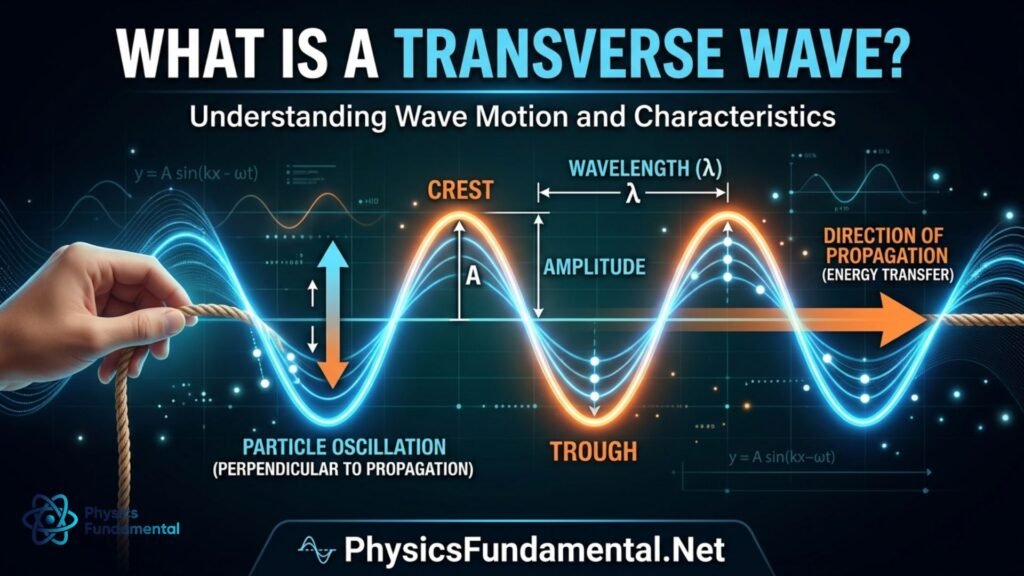
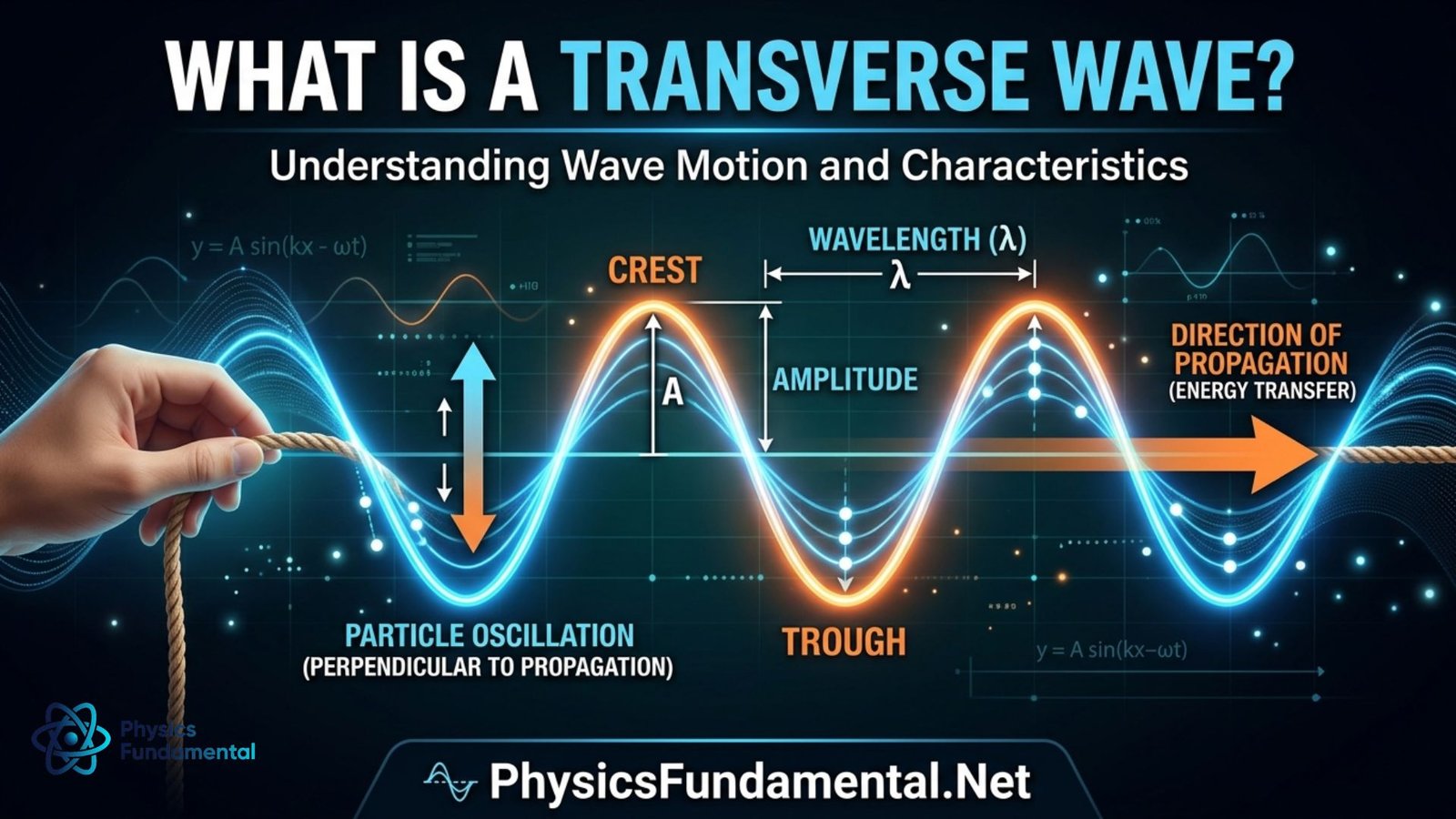
A Transverse Wave is a wave in which the vibration of the particles or field is perpendicular to the direction of wave propagation.
For example, consider a wave moving horizontally along a rope. If the rope moves vertically as the wave passes, the two directions are perpendicular.
If the wave travels in the x-direction, the particles may oscillate in the y-direction.
This can be represented as:
Direction of wave travel →
Particle motion ↑↓
The particles do not necessarily travel from one end of the medium to the other. Instead, they oscillate around their equilibrium positions while the disturbance and energy propagate through the medium.
transverse waves and wave motion
Transverse Wave Diagram
A simple transverse wave can be represented as:
             Crest                  Crest
               /\                    /\
              /  \                  /  \
-------------/----\----------------/----\------------- Equilibrium
            /      \              /      \
           /        \            /        \
          \/          \          \/          \
        Trough       Trough

<---------------- Direction of wave travel ---------------->
The highest points are called crests, while the lowest points are called troughs.
The horizontal distance between two consecutive crests or two consecutive troughs is the wavelength.
Main Parts of a Transverse Wave
Several important terms are used to describe transverse waves.
Crest
A crest is the point of maximum positive displacement from the equilibrium position.
In a typical diagram, it is the highest point of the wave.
Trough
A trough is the point of maximum negative displacement from the equilibrium position.
It appears as the lowest point of the wave.
Equilibrium Position
The equilibrium position is the undisturbed position of the medium.
The particles oscillate around this position as the wave passes.
Amplitude
Amplitude is the maximum displacement of a particle from its equilibrium position.
It is usually represented by A.
A larger amplitude generally means the wave carries more energy, although the exact relationship depends on the type of wave.
Wavelength
Wavelength is the distance between two successive points that are in the same phase.
It is represented by λ and measured in meters.
For example:
crest to crest = one wavelength
trough to trough = one wavelength
Properties of Transverse Waves
Transverse waves have several measurable properties.
Wavelength
Wavelength is represented by:
λ
It is the distance over which one complete wave cycle occurs.
Frequency
Frequency represents the number of complete oscillations occurring per second.
It is represented by f and measured in hertz (Hz).
1 Hz = 1 cycle per second
Period
The period is the time required for one complete oscillation.
It is represented by T.
The relationship between frequency and period is:
T = 1/f
and:
f = 1/T
Amplitude
Amplitude is the maximum displacement from equilibrium.
For many mechanical waves, increasing the amplitude increases the energy carried by the wave.
Wave Speed
Wave speed describes how quickly the disturbance travels.
The fundamental wave equation is:
v = fλ
where:
- v = wave speed
- f = frequency
- λ = wavelength
This equation is one of the most important formulas used for wave calculations.
Worked Example: Finding Wave Speed
A transverse wave has a frequency of 5 Hz and a wavelength of 2 m. Find its speed.
Use:
v = fλ
Substitute:
v = 5 × 2
Therefore:
v = 10 m/s
The wave travels at 10 m/s.
Worked Example: Finding Wavelength
A wave travels at 24 m/s and has a frequency of 6 Hz. Find its wavelength.
Using:
v = fλ
Rearrange:
λ = v/f
Substitute:
λ = 24/6
Therefore:
λ = 4 m
The wavelength is 4 m.
Mechanical Transverse Waves
Some transverse waves require a physical medium to travel.
Examples include waves on:
- Strings
- Ropes
- Some solid materials
- Earth’s crust
These are called mechanical waves because they involve the motion or deformation of matter.
A rope provides a simple demonstration. When one end is moved up and down, tension in the rope allows the disturbance to travel along it.
The rope’s particles move mainly perpendicular to the direction of propagation.
Electromagnetic Transverse Waves
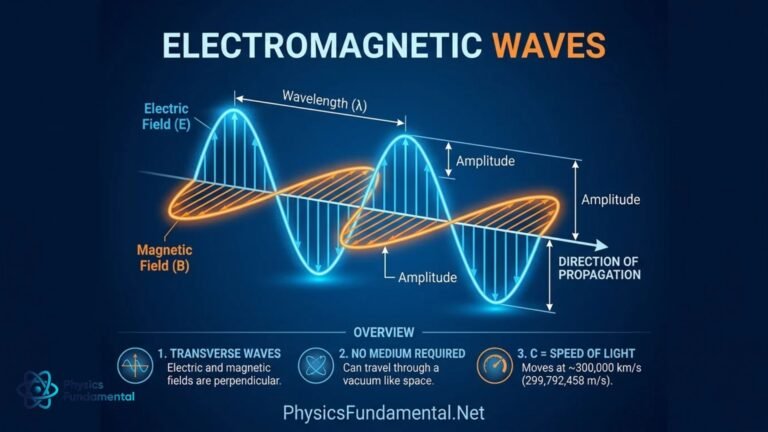
Electromagnetic waves are another major example of transverse waves.
They consist of oscillating electric and magnetic fields.
In an electromagnetic wave:
- The electric field oscillates perpendicular to the direction of propagation.
- The magnetic field oscillates perpendicular to the direction of propagation.
- The electric and magnetic fields are also perpendicular to each other.
In vacuum, electromagnetic waves travel at approximately:
c = 3.00 × 10⁸ m/s
Visible light, radio waves, microwaves, infrared radiation, ultraviolet radiation, X-rays, and gamma rays are all electromagnetic waves.
Unlike mechanical waves, electromagnetic waves do not require a material medium and can travel through a vacuum.
Examples of Transverse Waves
Waves on a Rope
A rope is one of the easiest ways to demonstrate transverse motion.
Moving one end vertically creates a disturbance that travels along the rope.
Waves on a String
Musical instruments provide another example. A vibrating guitar string produces waves along the string.
The vibration can create sound waves in the surrounding air.
Electromagnetic Waves
Light and other electromagnetic radiation are transverse waves.
Their electric and magnetic fields oscillate perpendicular to the direction of propagation.
Seismic S-Waves
Earthquakes generate different types of seismic waves.
S-waves, or secondary waves, involve transverse particle motion and travel through Earth’s solid interior.
Water Surface Waves
Surface waves on water can show transverse-like motion, although they are more complicated than an ideal transverse wave. Water particles generally move in combinations of vertical and horizontal motion.
Therefore, describing all water waves as purely transverse is an oversimplification.
Transverse Waves vs Longitudinal Waves
The main difference between transverse and longitudinal waves is the relationship between particle vibration and wave propagation.
| Property | Transverse Wave | Longitudinal Wave |
|---|---|---|
| Particle motion | Perpendicular to propagation | Parallel to propagation |
| Main features | Crests and troughs | Compressions and rarefactions |
| Example | Wave on a rope | Sound in air |
| Polarization | Possible for suitable waves | Not possible in the same transverse sense |
| Mechanical medium | Often solids/strings | Solids, liquids, and gases can support them |
A useful way to remember the difference is:
Transverse = across
Longitudinal = along
Transverse Wave Motion
Consider a rope stretched horizontally.
If the rope is disturbed vertically, each small section moves up and down.
At the same time, the disturbance travels along the rope.
This means:
Particle vibration ⟂ Wave propagation
The particles are not simply carried forward by the wave. Instead, energy is transferred through the medium as neighboring parts interact.
Energy Transfer in Transverse Waves
A wave transfers energy from one location to another without necessarily transporting the medium itself over the same distance.
For example, when a rope is shaken, energy from your hand travels along the rope.
The rope itself moves locally up and down, but the disturbance can travel a significant distance along its length.
The amount of energy carried by a wave is often related to its amplitude. For many ideal mechanical waves, greater amplitude corresponds to greater energy transport.
Polarization of Transverse Waves
Polarization is an important property of transverse waves.
A transverse wave can have its oscillations restricted to a particular direction.
For example, light can be polarized so that its electric field oscillates in a selected plane.
This is possible because electromagnetic waves are transverse.
Polarization provides strong evidence that light has transverse wave characteristics.
Longitudinal waves cannot be polarized in the same way because their particle motion is parallel to the direction of propagation.
You May Like to Read: Angular Momentum Explained: Powerful L = Iω Formula & Facts 2026
Frequency, Wavelength and Speed
The three quantities are connected by:
v = fλ
This means wave speed depends on frequency and wavelength.
For a wave traveling at a fixed speed, increasing frequency causes wavelength to decrease.
From:
λ = v/f
if v remains constant:
f ↑ → λ ↓
Similarly:
f ↓ → λ ↑
It is important to remember that changing frequency does not automatically mean the wave speed changes. Wave speed is generally determined by the properties of the medium for mechanical waves.
Transverse Wave Equation
An ideal sinusoidal transverse wave can be represented by:
y(x,t) = A sin(kx − ωt + φ)
where:
- A = amplitude
- k = wave number
- x = position
- ω = angular frequency
- t = time
- φ = phase constant
The wave number is:
k = 2π/λ
Angular frequency is:
ω = 2πf
The wave equation helps describe how displacement changes with both position and time.
Phase in a Transverse Wave
Two points on a wave are in phase when they have the same displacement and are moving in the same direction at the same time.
Points separated by one complete wavelength are in phase.
Therefore:
Phase difference = 2π × Δx/λ
where Δx is the distance between two points.
Points separated by half a wavelength have a phase difference of π radians, or 180°.
Reflection of Transverse Waves
When a transverse wave reaches a boundary, it can be reflected.
The behavior depends on the boundary conditions.
For example, a pulse traveling along a rope can reflect from a fixed end and return inverted.
At a free end, the reflected pulse can return without the same inversion.
Reflection is important in strings, wave experiments, optics, and many other physical systems.
Refraction of Transverse Waves
Refraction occurs when a wave changes speed as it enters a different medium or region.
If the speed changes while frequency remains constant, the wavelength also changes.
From:
v = fλ
if f remains constant:
λ = v/f
Therefore, a decrease in wave speed produces a shorter wavelength.
Light is a particularly important example because its speed changes when it passes from one transparent material to another.
Interference of Transverse Waves
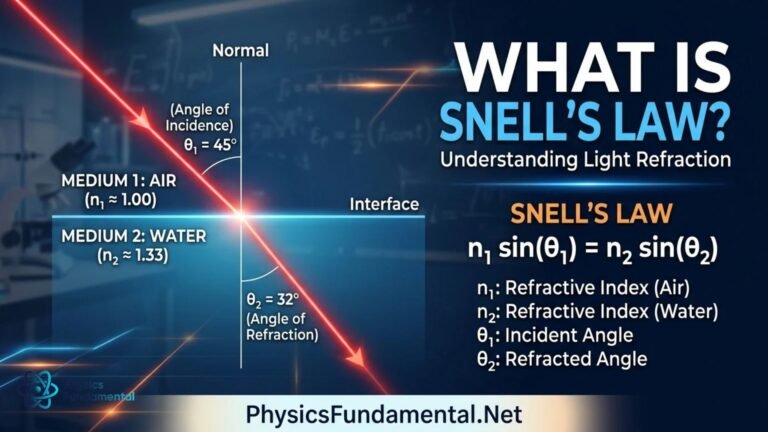
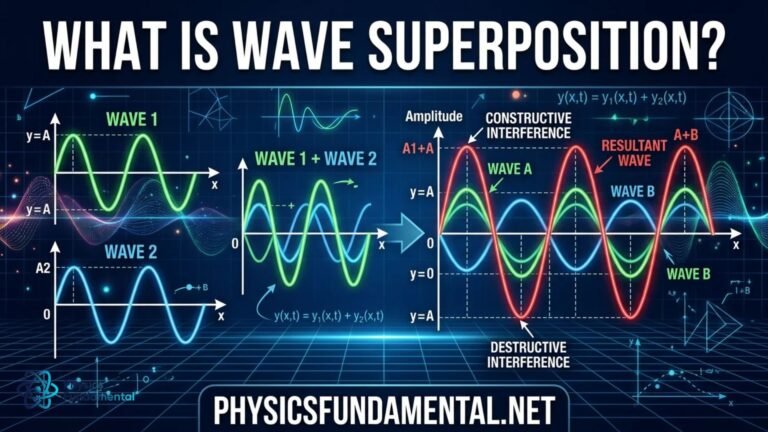
When two waves meet, their displacements combine according to the principle of superposition.
If two transverse waves meet:
y_total = y₁ + y₂
The result can be:
- Constructive interference
- Destructive interference
Constructive Interference
When waves meet in phase, their amplitudes can add.
For two equal waves:
A_total = 2A
Destructive Interference
When waves meet out of phase, their amplitudes can partially or completely cancel.
For two equal waves that are exactly out of phase:
A_total = 0
Interference is important in strings, water waves, light, sound-related systems, and many other wave phenomena.
Common Mistakes About Transverse Waves
Thinking the Particles Travel With the Wave
The particles of the medium usually oscillate around their equilibrium positions. The wave disturbance and energy propagate through the medium.
Confusing Amplitude With Wavelength
Amplitude is a vertical displacement in a typical diagram, while wavelength is a horizontal distance between corresponding points.
Assuming Every Wave Is Mechanical
Electromagnetic waves can travel through a vacuum and do not require matter as a medium.
Calling Every Water Wave Purely Transverse
Surface water waves involve more complicated particle motion and are not perfectly transverse.
Confusing Frequency With Wave Speed
Frequency describes how many cycles occur per second. Wave speed describes how quickly the disturbance propagates.
How to Identify a Transverse Wave
You can identify a transverse wave by asking one simple question:
Is the vibration perpendicular to the direction of propagation?
If the answer is yes, the wave has transverse characteristics.
For example:
- Wave moves right → particle moves up and down: transverse
- Wave moves right → particle moves left and right: longitudinal
This distinction is one of the easiest ways to classify waves.
Formula Summary
The main formulas associated with transverse waves include:
v = fλ
T = 1/f
f = 1/T
k = 2π/λ
ω = 2πf
y(x,t) = A sin(kx − ωt + φ)
For wave interference:
y_total = y₁ + y₂
These equations allow you to calculate wave speed, frequency, wavelength, period, phase, and displacement.
Frequently Asked Questions
What is a transverse wave?
A transverse wave is a wave in which the vibration is perpendicular to the direction in which the wave travels.
What are examples of transverse waves?
Examples include waves on strings, electromagnetic waves, and seismic S-waves.
What is the formula for wave speed?
The basic wave-speed formula is v = fλ, where v is speed, f is frequency, and λ is wavelength.
What is the difference between transverse and longitudinal waves?
In transverse waves, particles vibrate perpendicular to propagation. In longitudinal waves, particles vibrate parallel to propagation.
Can transverse waves travel through a vacuum?
Electromagnetic transverse waves can travel through a vacuum, but mechanical transverse waves require a suitable physical medium.
Conclusion
A Transverse Wave is characterized by particle or field oscillations that are perpendicular to the direction of wave propagation. Its most recognizable features are crests and troughs, while amplitude, wavelength, frequency, period, and speed describe its measurable properties.
The fundamental relationship v = fλ connects wave speed, frequency, and wavelength. Transverse waves can also reflect, refract, interfere, and, in appropriate cases, become polarized.
From waves traveling along strings to electromagnetic radiation crossing space, transverse wave behavior is an essential part of physics. Understanding the direction of particle motion compared with the direction of propagation provides the key to recognizing and analyzing these waves.