Kinetic Theory of Gases: Powerful Pressure & Molecular Motion Guide 2026
Kinetic molecular theory: how molecular motion creates pressure and temperature. Covers the 5 postulates, RMS speed, and ideal gas law derivation.

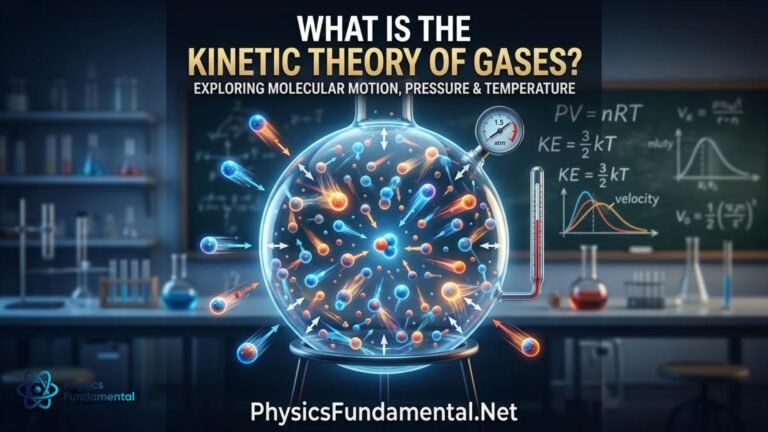
Kinetic molecular theory: how molecular motion creates pressure and temperature. Covers the 5 postulates, RMS speed, and ideal gas law derivation.
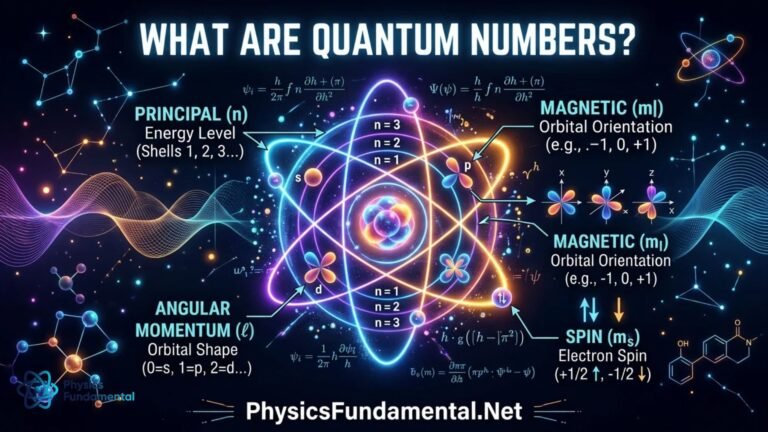
Four quantum numbers n, l, m_l, m_s describe each electron state. Principal, angular momentum, magnetic, spin. Pauli exclusion principle and electron configuration explained.

What happens when an object falls through the air? At first, it may speed up rapidly, but after some time, its acceleration can decrease until it moves at a constant speed. This change in motion is explained by two important physics concepts: free fall and terminal velocity. Free fall describes motion under the influence of…

How momentum is conserved in collisions — the key difference between elastic and inelastic impacts, the impulse-momentum theorem, and worked examples.
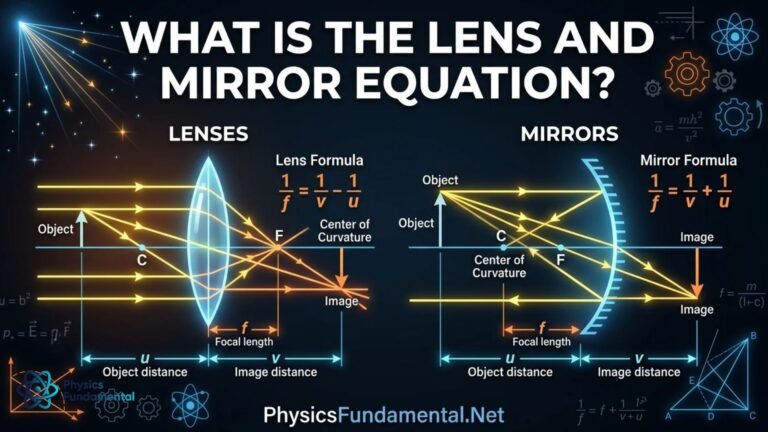
The lens and mirror equation 1/f = 1/u + 1/v explained: sign conventions, magnification, real vs virtual images, and worked examples for lenses and curved mirrors.
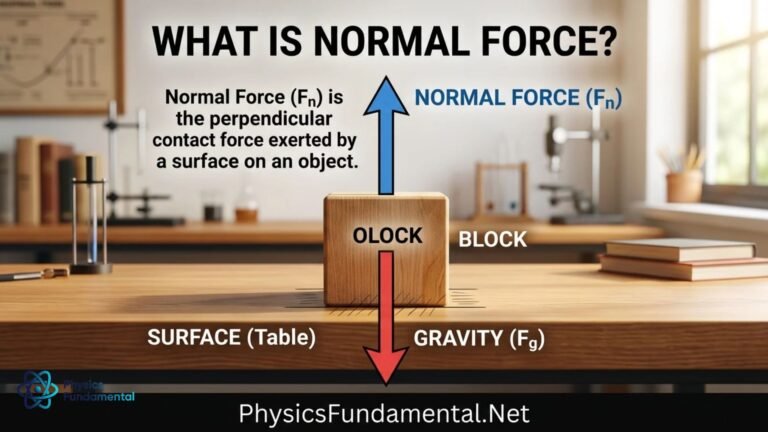
Why doesn’t a book simply fall through a table when gravity pulls it downward? The answer is the normal force. This contact force acts between surfaces and can support an object against gravity or other forces. The normal force is a contact force that acts perpendicular, or normal, to the surface touching an object. In…
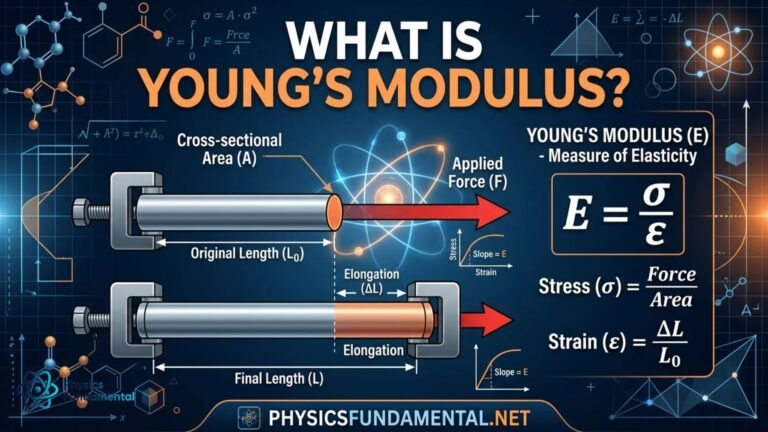
Stress σ = F/A (Pa), strain ε = ΔL/L₀ (dimensionless), Young’s modulus E = σ/ε (Pa). Elastic and plastic deformation, stress-strain graph, and 4 worked examples.
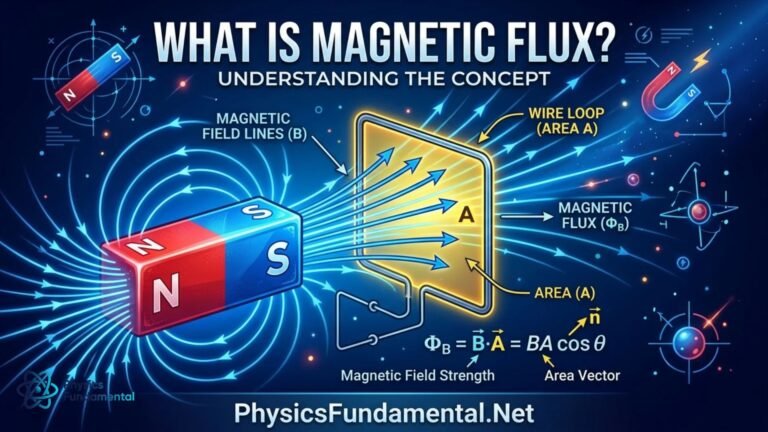
Magnetic flux Φ = BAcosθ and Faraday’s law EMF = −NdΦ/dt. Lenz’s law sign explained, electromagnetic induction, flux linkage, generators, and 4 worked examples.
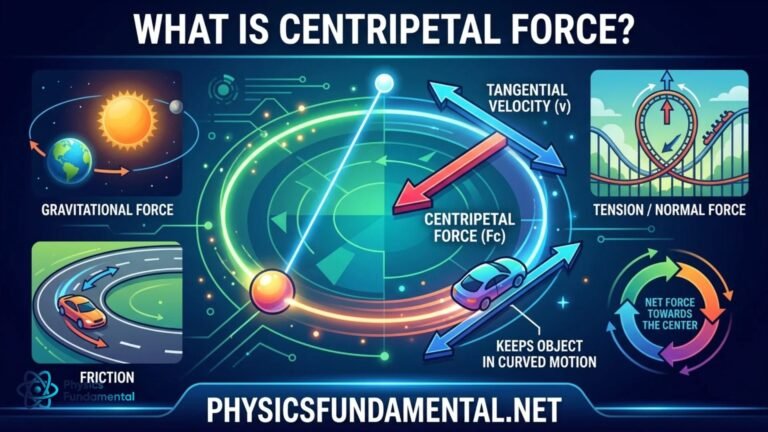
Why does a car stay on a curved road instead of continuing straight? Why does a ball tied to a string move in a circle instead of flying away? The answer is centripetal force. It is the inward-directed force that continually changes an object’s direction and keeps it moving along a circular path. Centripetal force…
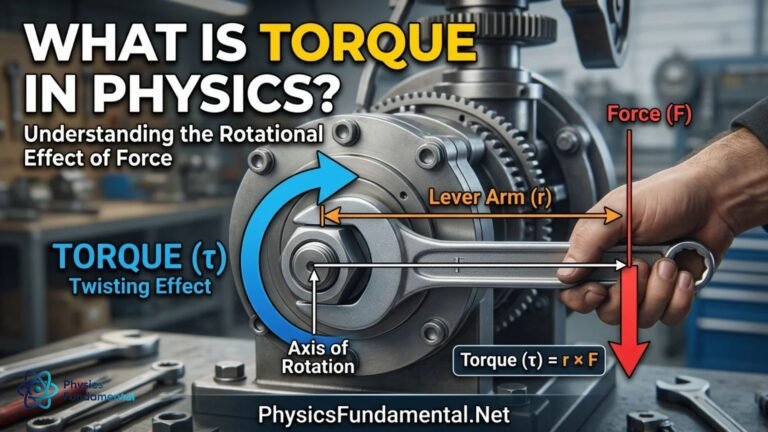
Why is it easier to open a door by pushing near the handle than by pushing close to the hinges? The force may be the same, but the distance from the pivot changes the turning effect. This turning effect is known as torque. Torque is one of the most important concepts in rotational motion. It…